About Zygiella x-notata (Clerck, 1757)
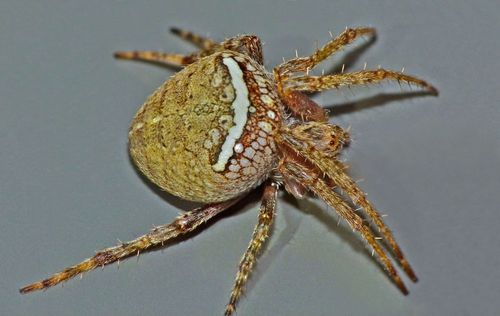
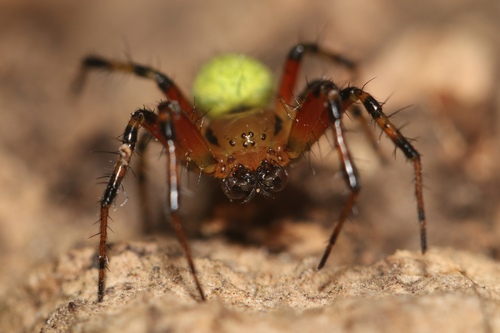
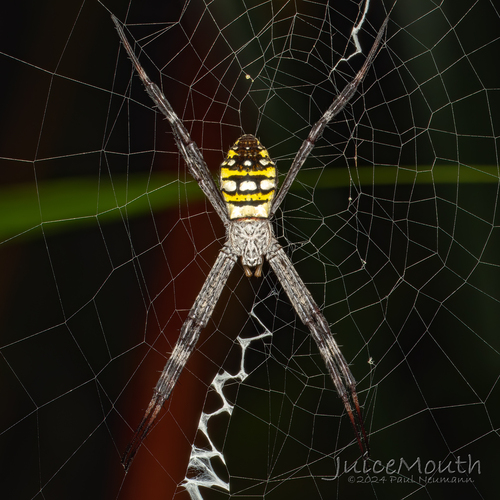
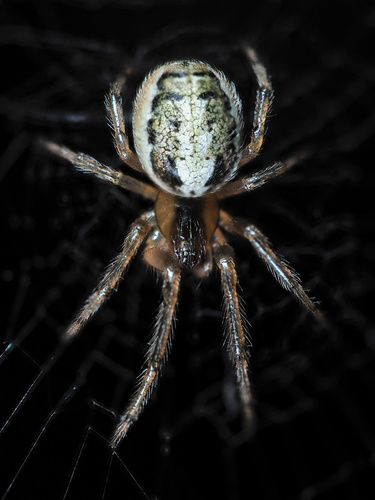
Zygiella x-notata (Clerck, 1757) is a species of orb-weaving spider. Adult females measure 5–11mm in body length, with a carapace width of 1.5mm, while adult males reach a maximum body length of 7mm, making them smaller than females. The dorsal tibia of the walking legs and pedipalps hold a group of trichobothria, and there is only one sensillum on the leg metatarsus. The prosoma is yellow-brown, and the opisthosoma bears a leaf-like mark. The abdomen has a silvery sheen caused by guanine crystals located beneath the outer skin. Adult females can be identified by their grey-banded legs and the pattern of dark grey waves on their dorsal side. Adult males have a dark dorsal exterior, with dark brown legs and cephalothorax. The male abdomen is smaller, less patterned, and a shiny cream color compared to the female abdomen. In moderate climates, adult spiders appear from July to October, and sometimes even into December. In warmer regions, Z. x-notata remains active year round. This species is well known for weaving missed sector orb webs, a flexible form of web building. While web construction behavior is innate, these spiders flexibly alter their webs to suit their own advantage and safety. Based on the location of their retreat, Zygiella species typically leave an empty missing sector, especially when building webs on door or window frames. Sometimes after completing a full web, spiders return to fill in the missing sector, or leave one sector unfilled depending on the circumstances. The missing sector is created either by switching spiral direction in that region, or by biting through threads to remove spirals from the section after building the full web. Zygiella x-notata is common in human-inhabited areas, including boats and docks, and is also found on urban vegetation such as bushes and shrubs. Females preferentially build orb webs near human settlements, where they live through their adult lives. It has also been found on cliffs and bushes in Britain and across Europe. This species is native to Europe, and is invasive in some coastal areas of the Americas. It can also be found in a number of other locations around the world. It is abundant in the west Palearctic region, and distributed across the Holarctic. It is primarily widespread across much of Britain, as well as Western and Central Europe. It is also common in New Zealand, and is occasionally found in South Africa, Mexico, Colombia, Ecuador, Panama and Honduras. Zygiella x-notata has an annual life cycle. Females lay eggs in autumn, most often during September and October. Males die shortly after mating, while surviving females protect the egg sacs over winter from Hymenopteran parasites. Egg sacs hatch in spring, after which spiderlings disperse. Spiderlings reach their adult instar in August, when mating begins again and the cycle restarts. After reaching the adult stage, female Zygiella x-notata have a lifespan of approximately 5–7 months.