About Zygaena viciae (Denis & Schiffermüller), 1775
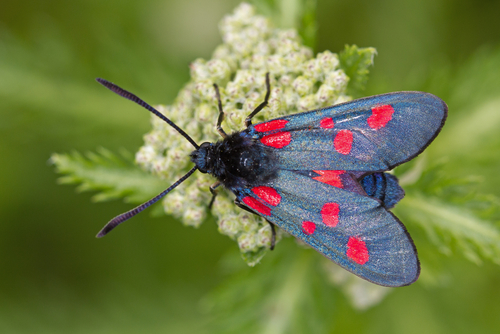
Zygaena viciae, commonly called the New Forest burnet moth, is a species of moth in the Zygaenidae family that is found across the northern hemisphere. This species takes its common name from the New Forest, England, where it has been extinct since 1927. In Europe, it is also known by the name small five-spotted ram. This moth occurs across southern and central Europe, and a subspecies Z. v. argylliensis survives in very small numbers in Scotland. It can also be found in southern Scandinavia. To the east, its range extends as far as Lake Baikal. Females lay pale green or pale yellow eggs in clusters. Larvae of this species feed on the leaves of clover and vetch species. Larval appearance varies across regions, but they are generally green with yellow and black spots. The species pupates inside a cocoon attached to plant foliage. Adult New Forest burnet moths have a wingspan of 22 to 32 mm. They are day-flying moths and are active on the wing during the month of July.