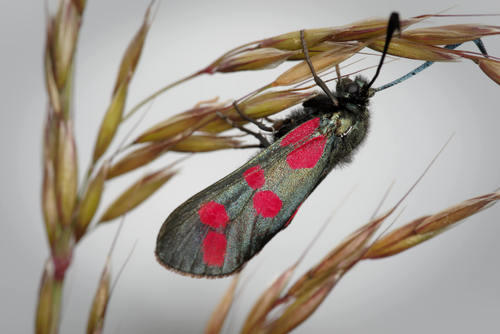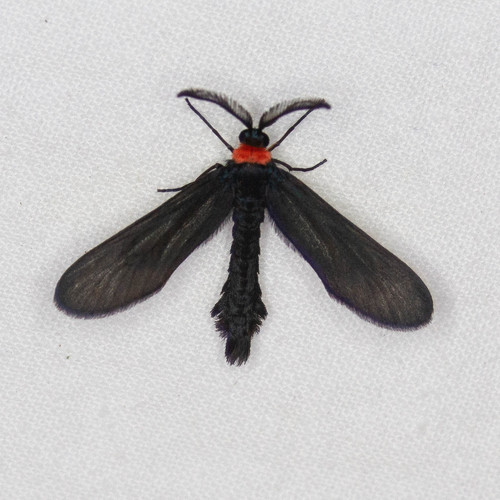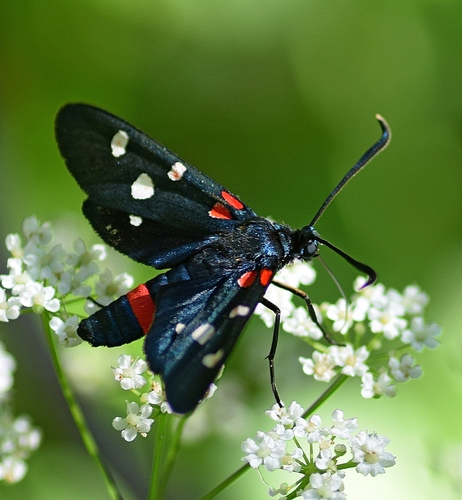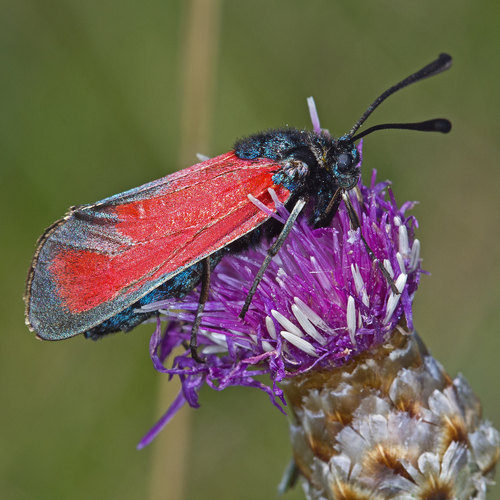
About Zygaena trifolii (Esper, 1783)
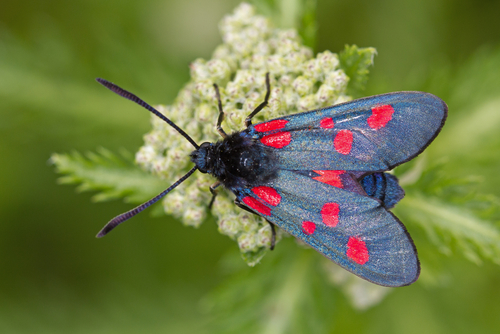
Zygaena trifolii (Esper, 1783) has a wingspan of 28–33 mm. Adults fly from mid-June to early August, producing one generation per year. Eggs are pale yellow, laid in multiple layers to form an irregularly shaped batch. Larvae feed on the leaves of greater bird's-foot trefoil (Lotus uliginosus) and bird's-foot trefoil (Lotus corniculatus). This species overwinters in the larval stage, and may overwinter twice. The pupa is shiny, black or blackish-brown, and measures 10–18 mm long. Pupation of the subspecies descreta occurs in June and July inside a cocoon spun high on marsh vegetation such as soft rush (Juncus effusus). Pupation of the subspecies palustrella takes place close to the ground, concealed among grass and other low herbage, from late April to May. The cocoon is fusiform, with irregular ribs, and ranges in color from dirty white to creamy white to bright yellow. This species is distributed across North Africa (Algeria, Morocco, and Tunisia), extending through the western Mediterranean, Great Britain, and central Europe to Ukraine. It does not occur in Scandinavia.