About Zygaena transalpina Esper, 1780
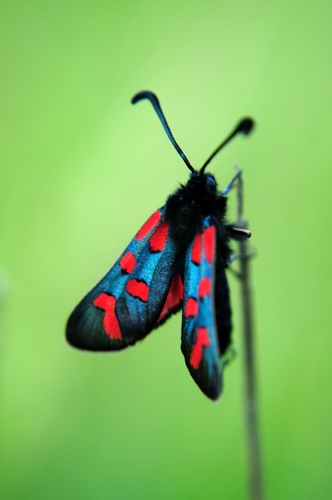
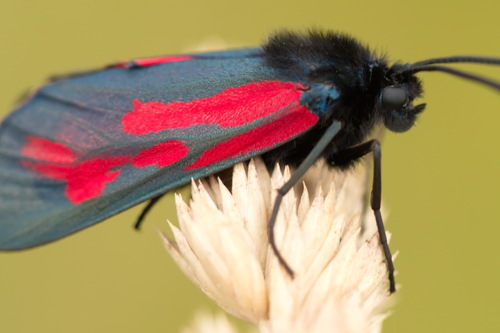
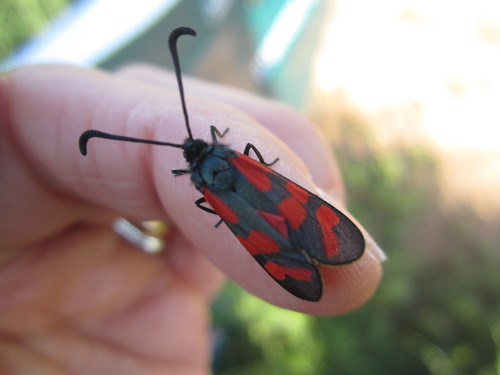
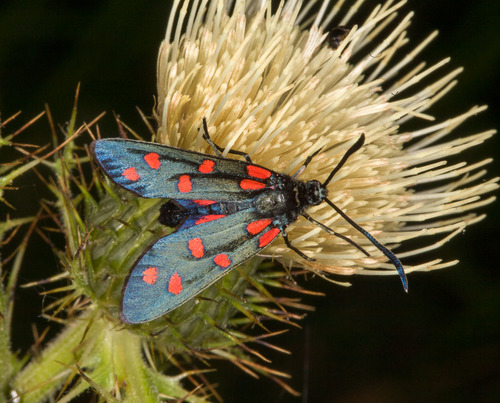
Zygaena transalpina Esper, 1780 is a moth species with a wingspan that reaches 29–35 millimetres (1.1–1.4 in). Its forewings are shining bluish-green or blue-black, with three pairs of carmine-red spots per wing; some individuals of both sexes only have five spots total. The two basal spots on the forewings are oval. The hindwings are carmine red, with a black-blue border and a slightly darker fringe. The underside of the forewings is light black-blue, and usually has the same spots as the upper side. As described by Seitz, this species is very highly coloured: it has a metallic black-blue or metallic black-green ground color, with six small, widely separated red spots that each have a slight black edge. The hindwings are very bright red with a broad black margin. In the name-typical form, all red spots on the underside of the forewing are merged. A number of aberrations, subspecies and taxonomic variants have been recorded: aberration flava Dziurz. is an accidental light-yellow morph. Aberration ferulae Led., currently a synonym of Z. transalpina, occurs in the southern Alps and ranges sporadically into Southern Germany; it is red, has even smaller forewing spots than the name-typical form, and can barely be separated as a distinct form. In aberration nigricans Oberth. (= brunnea Dziurz.), all red coloration shifts to coffee brown, matching the appearance of ab. chrysanthemi of Zygaena filipendulae. boisduvali Costa (= xanthographa Germ.) is found in South Italy; it has 5 or 6 yellow spots on the forewings and a yellow streak or heart-shaped spot on an otherwise black hindwing. Aberration zickerti Hofm., currently a synonym of subspecies xanthographa Germar, 1836, is similar to boisduvali, but its hindwing is entirely black with no central yellow spot, and it flies rarely alongside similar variants. astragali Bkh. (= hippocrepidis Hbn.; angelicae Boisd.), now a recognized subspecies, is a northern form occurring in France, South and Central Germany, and Belgium, with unconfirmed reports of it ranging as far as Sweden. It has a magnificent bright vermilion color, six large forewing spots, and a narrow marginal band on the hindwings; the underside of the forewing is uniformly vermilion with no separated spots, only a black margin. Specimens of this subspecies with an abdominal belt are named astragali aberration cingulata by Hirschke. miltosa Cand., now a subspecies, was founded on a small specimen from La Rochelle where the dorsal spots are also confluent. sorrentina Stgr., a synonym of subspecies xanthographa Germar, 1836, resembles boisduvali but has red spots, and the hindwing spot is often very small; it is found in Southern Central Italy (Naples). calabrica Calb. (= spicae Stgr.), also a synonym of subspecies xanthographa Germar, 1836, is almost entirely black, with very small red spots, and the hindwing spot is only a vestige, giving it a similar appearance to Zygaena stoechadis; it is found in South Italy. maritima Oberth., now a recognized subspecies, is bright red like the name-typical form, but the black margin of the hindwing is wider and more sinuate, and the six forewing spots on the underside are not confluent; it occurs on the Riviera. italica Dziurz., a synonym of subspecies collina Burgeff, 1926, matches maritima but only has five spots; it is found in Northern Italy. The larva of Zygaena transalpina is green, with a black dorsal stripe, a yellow lateral line, and triangular black spots above the lateral line. The pupa is black, with a greenish white abdomen, and develops inside a light-yellow cocoon. This species is very similar to Zygaena filipendulae, but can be distinguished by the color and shape of the antenna apex: the apex is whitish and sharper in Z. transalpina, and black in Z. filipendulae. Additionally, when present in Z. transalpina, the sixth spot is clearly separated from the fifth spot, and even the third and fourth spots are more widely spaced than they are in Z. filipendulae. This species is distributed from Germany to Croatia and Italy, and from Spain to Austria and Slovenia. It occurs most often above 2,000 meters of altitude in the Alps, especially in the Italian Alps and mainland Italy; it is not found in Sicily or along the Adriatic coast. This moth inhabits warm, dry environments, particularly dry meadows, and also occurs in flowering grasslands at higher elevations. The subspecies astragali ranges north past 50° latitude, and is still common near Mombach (Mainz), Darmstadt, and other localities in that region. Southern Europe, especially Italy, is considered the main range of the species; forms found here fly from May to July in surprisingly large numbers. The subspecies maritima flies in great abundance even in dull weather, and continues flying until nightfall on the southern slopes of the Riviera near Genoa, Pegli, Savona, and other nearby locations. Name-typical Z. transalpina is also very common in the southern valleys of the Ticino Alps, and ranges into the North Italian plains.