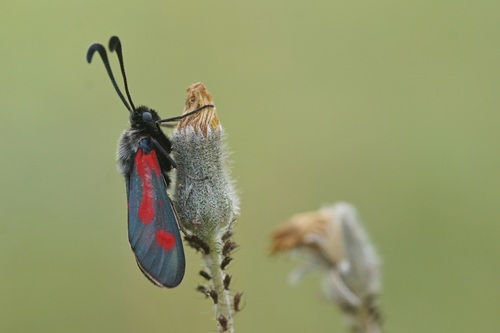
About Zygaena sarpedon Hübner, 1790
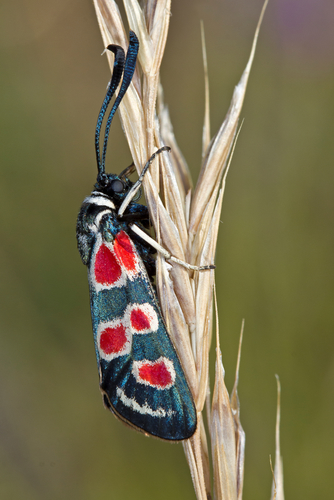
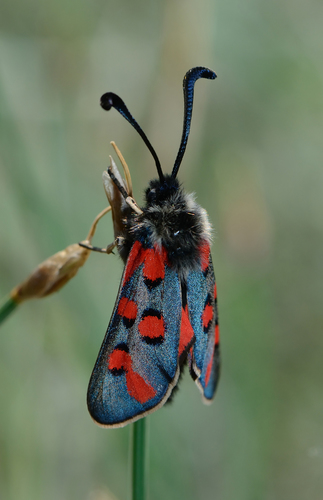
This species, Zygaena sarpedon Hübner 1790, is the first member of a group of red-banded Burnet moths from Mediterranean coasts that have only three red spots on the forewing: the anterior and posterior wedge-shaped spots, and a small, rounded drop-like spot that corresponds to the distal portion of the central streak. The name-typical form, small sarpedon Hbn., has pale but distinctly red coloration, and a glassy transparent streak running from the base to the middle of the hindwing. It is found in Spain and southern France. The form trimaculata Esp. is slightly larger, with entirely transparent wings. The red spots on its forewing are only faintly marked, and the hindwing is almost entirely transparent. It occurs in the Balearic Islands, and may occasionally also appear alongside the name-typical form. The form balearica Boisd. (= sarpedon H. Sch.) is considerably larger and more densely scaled than the two preceding forms. Its hindwing is a vivid red, with a narrow black edge. It is found in Spain, southern France, and Piemont. The taxon vernetensis Oberth. is a junior synonym of sarpedon ssp. carmencita Oberthür, 1910 from the Pyrenees; it has forewing matching that of balearica, but a black hindwing with two red streaks, one in the cell and one below the cell. In addition to these partly geographical forms, two named aberrations are recognized: ab. flava Oberth., which is light yellow, and ab. confluens Dziurz., which has confluent spots. The larva is highly variable in patterning. It is green, with brown subdorsal and lateral lines, a subdorsal row of black dots, black stigmata, and a black head edged with reddish. It develops until June, feeding on Eryngium. The pupa forms inside a brown cocoon. The adult imago flies in July and August over stubble and sunny fallow fields. The wingspan of the species ranges from 24 to 28 mm.