About Zygaena rhadamanthus Esper, 1789
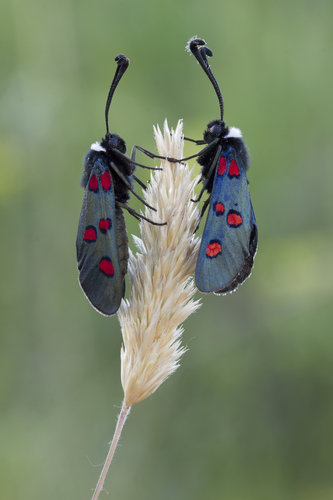
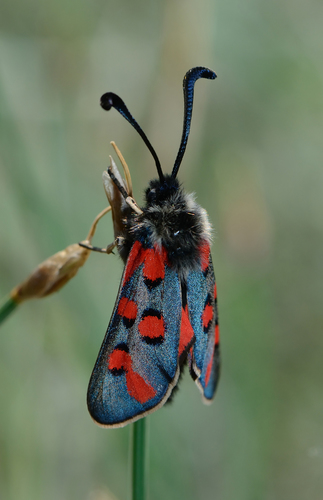
The technical description and variation for Zygaena rhadamanthus Esper, 1789 (abbreviated Z. rhadamanthus Esp.) is as follows. The forewing of the typical form is strongly transparent, glossy grey, and marked with 6 red spots. Spots 2, 3, 4, and 5 are edged in black on both their proximal and distal sides. The typical form is found in the Riviera and Catalonia. The aberration cingulata Led. of Z. rhadamanthus has a red belt. This form is normal in Spain, while only single individuals occur alongside typical specimens in Liguria. The subspecies Z. rhadamanthus kiesenwetteri (Z. rhadamanthus ssp. kiesenwetteri Herrich-Schäffer, 1852, abbreviated kiesenwetteri H.-Sch.) has a very different appearance, due to the deep black ground color of its forewing and its black hindwing. It resembles Zygaena lavandulae or Zygaena stoechadis, but the black edges of the forewing spots are easily visible against the black ground. The subspecies Z. rhadamanthus algarbiensis (Z. rhadamanthus ssp. algarbiensis Christ, 1889, abbreviated algarbiensis Christ., with the synonym roederi Stgr.) originates from South Portugal. It is similar to subspecies kiesenwetteri, but the 6th forewing spot is entirely gone or only faintly vestigial. The larva is variegated, with grey and black base color, and longitudinal stripes in white and yellow. It has a red collar. It is full-grown in April, feeding on Dorycnium. The pupa forms inside a white oval cocoon. Adult moths fly from spring through May, and are frequently found resting on grass stalks.