About Zygaena purpuralis Brünnich, 1763
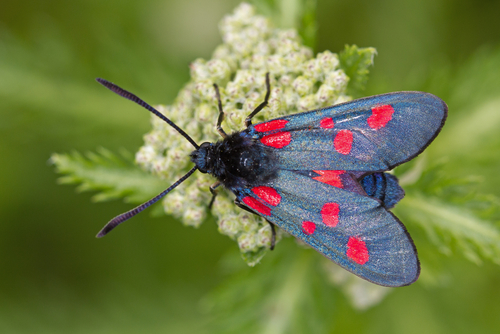
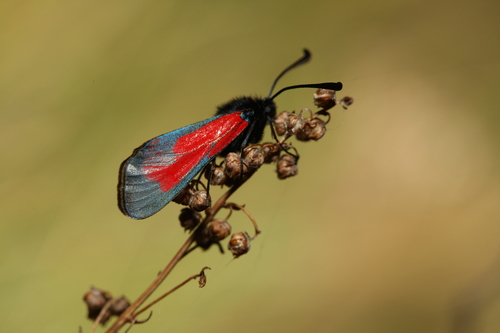
Zygaena purpuralis (Brünnich, 1763) is a medium-sized moth with a wingspan of 30–34 millimetres (1.2–1.3 in). Most individuals have forewings marked with three bright red, shape-variable longitudinal streaks that have nearly transparent greyish-bluish edges. Hindwings are mostly or almost entirely bright red. Its head and thorax are black, while the abdomen is dark blue. The larvae are yellow, with lines of small black spots. Per Seitz’s technical description and variation notes, this species, previously called Zygaena pilosellae Esp. and Zygaena minos Fuessl., has a completely black forewing hindmargin including the base; the red wedge-shaped spots in front of this margin can match the shape seen in Zygaena erythrus Hbn. An aberration with light yellow markings in place of red, first recorded by Ochsenheimer, was later named ab. grossmanni (also called lutescens Tutt) by Ruhl; this form has been reported to be constant or predominant in a few very limited localities. In aberration obscura Tutt, the entire wings, including the original red coloration, are darkened. The taxon sareptensis Stgr.-Reb., now classified as Zygaena minos ssp. sareptensis Rebel, 1901, is a large, somewhat paler form with lighter red coloration found in South Russia. The taxon diaphana Stgr., now Zygaena minos ssp. diaphana Staudinger, 1887 from Tauria, has thinly scaled, strongly transparent wings, with the central wedge-shaped spot noticeably widened at its distal end. The subspecies nubigena Led. is a very thinly scaled form from the high mountains of Europe and Asia; like many mountain forms, it has a very shaggy body similar to Zygaena exulans, and it occasionally occurs alongside Zygaena exulans. The taxon smirnovi Christ., now Zygaena minos ssp. smirnovi Christoph, 1884 from Turkestan, is a rather large form where the distal wedge-shaped spot is constricted before its widened apex. The taxon pluto O. (also called pythia Hbn.) is a synonym of Z. purpuralis; this form has a black apex on the hindwing, and the central forewing streak is consistently even in width, with no distal widening, and occurs in South Europe ranging north to Austria. The taxon polygalae Esp., now classified as Zygaena filipendulae ssp. polygalae Esper, 1783, has completely lost the black spaces between the red streaks, with red extending far enough across the forewing that only the forewing edge remains black, this is especially pronounced in females. It differs from Zygaena rubicundus in retaining a black forewing hindmargin, though the black margin is sometimes narrow, and occurs in Southern Europe, particularly Northern Italy. The taxon heringi Zell., a synonym of Z. purpuralis from North Germany, has thinner antennae, and the central wedge-shaped spot of its slightly broader forewings extends close to the distal edge. The taxon ab. interrupta Stgr., a synonym for Zygaena minos ssp. pimpinellae, has a broadly interrupted central streak, and the posterior streak is often constricted in its middle; this form occurs more often in the northern part of the species’ range, alongside the typical form. When all three red streaks are interrupted, the red color is split into six separate spots, matching the pattern of other Zygaena species; this form is ab. sexmaculata Burgeff. Finally, some specimens have a red belt on the abdomen, classified as ab. cingulata Burgeff. More detailed larval description notes it is bluish white or light yellow, with a subdorsal row of prominent black dots, and has black head, pectoral legs and stigmata. This species occurs across most of western, central and southern Europe, ranging from Ireland and France east through Asia Minor, the Caucasus, Russia, and across the Palearctic to the Altai Mountains. It inhabits sunny grassy slopes, areas below cliffs, and dry grassland.