About Zygaena punctum Ochsenheimer, 1808
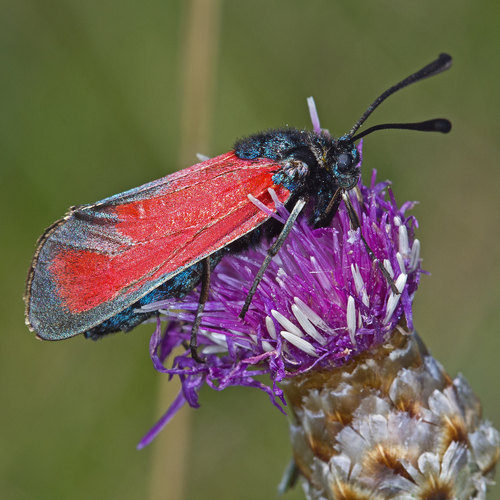
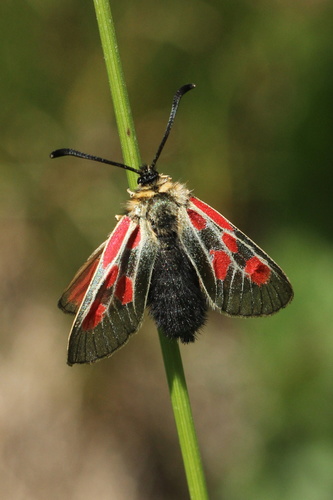
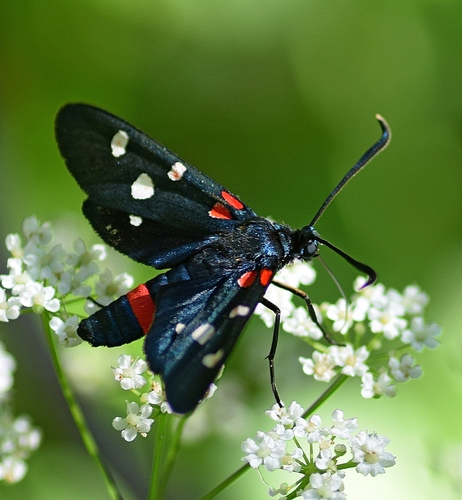
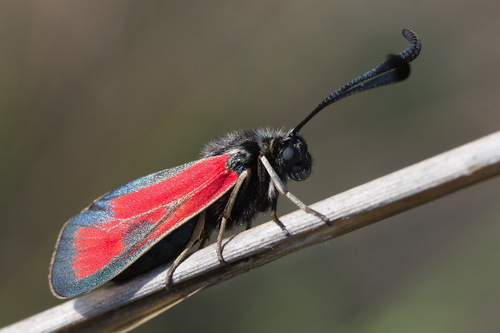
This section provides a technical description and variation of Zygaena punctum Ochsenheimer, 1808, originally documented by Seitz. Z. punctum O. fills the ecological position of the related African species Zygaena favonia Frr. in Southern Europe. The placement of its red spots matches that of Zygaena sarpedon, but its apical spot is enlarged, faded-looking, with a deeper red center and paler edges. A red abdominal belt is always absent in this species. The nominate name-typical form of punctum is found along the northeastern coasts of the Mediterranean Sea, extending as far as Armenia. It is small, with forewing markings that are more or less confluent, leaving the hindmargin broadly black. The subspecies Zygaena punctum dystrepta Fischer de Waldheim, 1832 (previously named dystrepta Fisch.-Wald.) is found in Southeastern Europe and Asia Minor; it only has a very narrow black shade along the hindmargin, and the forewing is otherwise all blood-red except for the distal margin. A specimen from Asia Minor received from Messrs. Staudinger and Bang-Haas under the name malatina has this red color replaced by miniate, the color of red lead or vermilion. italica Stgr.-Reb., now a synonym of Z. punctum, is a more densely scaled, brighter-colored form from Southern and Central Italy. In this form, the apical patch is distinctly separated from the basal area by a narrow black interspace. The larger form contamineoides Stgr. (currently Z. punctum ssp. ledereri Rambur, 1858, previously called contaminei Zell and dalmatina H.-Sch.) occurs in Spain, Italy, and Sicily; it has a broad interspace that completely isolates the apical spot. The larva is greenish, with a white dorsal line, subdorsal rows of black dots, and larger yellow spots below these rows. The head and thoracic legs are black, and the abdominal legs are yellow. Larvae are found in May and June feeding on Eryngium. The adult imago emerges in July; it occurs in very limited localities, but is rather common within those areas, and flies low to the ground. The wingspan of the adult is 25–30 mm.