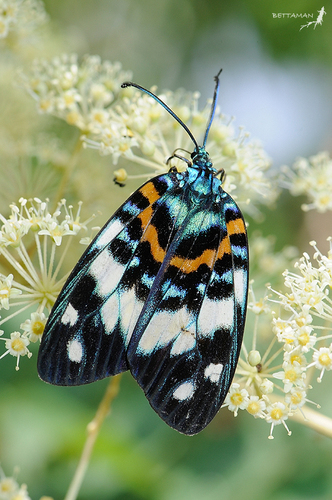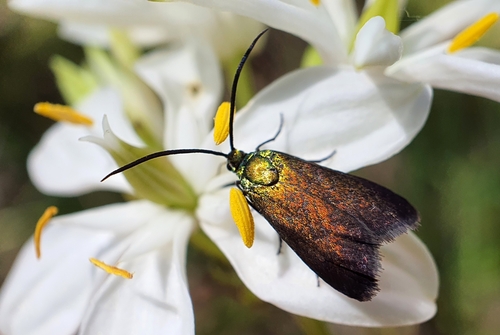
About Zygaena loti (Denis & Schiffermüller), 1775
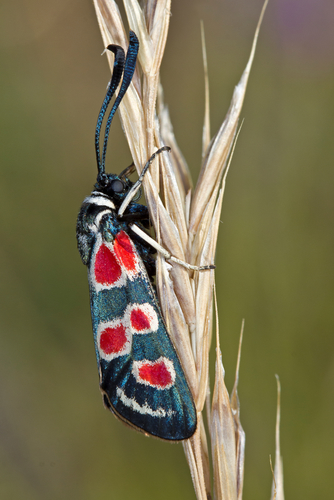
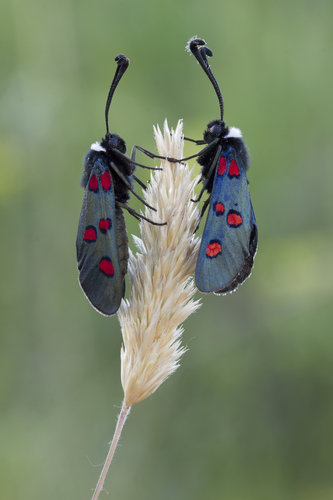
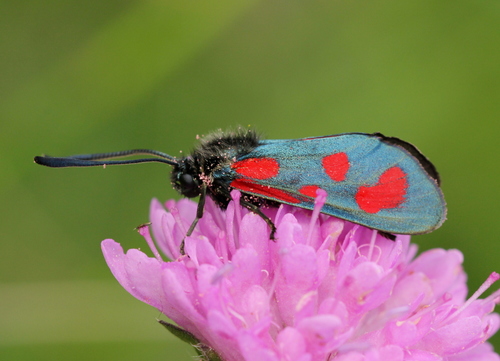
Zygaena loti, commonly known as the slender Scotch burnet moth, belongs to the order Lepidoptera (which includes all butterflies and moths) and the family Zygaenidae. Unlike most nocturnal moths, all Zygaenidae moths are day-flying, or diurnal. Z. loti is additionally classified as highly sedentary. This moth has a wingspan of 25 to 35 millimeters. It can be identified by its relatively small black body, light-colored legs, and a pair of rounded wings that are either black or light brown with red spots. The species displays sexual dimorphism: female wings are much lighter in scaling than males of the same species, and females have a double white ruff. Male forewings are grayish-blue, while female forewings are yellow-gray; both have six red spots that sometimes partially flow together. The kidney-shaped spot at the tip of the forewing is actually formed by the fused fifth and sixth spots. Hindwings are red with a black border. Zygaena loti is quite similar in appearance to Zygaena exulans, Zygaena filipendulae, and Zygaena lonicerae. Fully grown caterpillars reach a length of about 20 millimeters (0.79 inches). They are olive-green or yellow-green, with two yellow and two black dots on each body segment, and short white hairs. The geographic distribution of Zygaena loti is well documented, but not uniformly reported across research studies. Some sources note the species as occurring mainly in western Scotland, confined only to the Isles of Mull and Ulva, but this refers solely to the subspecies scotica. Members of the Zygaenidae family are widespread across the European continent, and Z. loti itself is found across most of Europe, with the exceptions of Ireland, the Netherlands, Portugal, Fennoscandia, Denmark, Estonia, and Latvia. It occurs on the Iberian Peninsula in Spain, across central and southern Europe, and extends east to Siberia. While it is uncommon in northern Europe, an isolated population exists in Scotland. Historically, the species had a wide distribution with a network of interconnected populations, but agricultural land expansion and resulting habitat loss have left most Z. loti and Zygaenidae populations fragmented and isolated from one another. This isolation has led to high levels of genetic differentiation between Z. loti populations. The total distribution range of the moth has declined since the 1970s. Although Z. loti is fairly widespread overall, it can only survive in a narrow range of habitats, which makes it a useful indicator species for environmental change — a characteristic many conservationists have focused on. The moth is typically restricted to xerothermic environments, meaning it thrives in hot, dry climates, and it strongly prefers lime-rich conditions. Suitable habitats for Z. loti include flowering meadows, clearings, subalpine or rocky slopes, scrubland, forest edges, limestone formations, and dry grassland, usually found at elevations up to 2,100 metres (6,900 ft) above sea level. For Zygaenidae as a whole, the Alps and Pyrenees are considered biodiversity hotspots. The full life cycle of Zygaena loti has not been extensively studied, but available information supports the following likely outline. As an early burnet species, Z. loti caterpillars exit diapause between late February and early March. Caterpillars hide during the day in moss layers or among herbage made up of small, short plants less than 6 cm tall. They spin oval-shaped, dull dirty whitish cocoons in these locations to enter the pupal stage, before maturing into adult moths from May to early June. Adult flight occurs from late May to early August, depending on eclosion timing. As a diurnal species, adults only fly during the day. After mating, females lay eggs on larval food plants. The resulting larvae feed from approximately August to early May, and overwinter once, and sometimes twice, in a larval diapaused state. Little specific information exists about the reproductive strategies of Zygaena loti, but studies of Z. loti and other Zygaenidae have documented the shared mating routine of the family. Zygaenidae use a dual partner-finding strategy, typical for most moths, meaning both females and males participate in locating a mate. Females have pheromone glands on their ovipositor, located at the tip of the abdomen, which release a pheromone to attract conspecific males. There is tentative evidence that females do not use pheromones during morning hours, though further research is required to confirm this. Females also exhibit calling behavior, where they hold their body in a position that leaves the pheromone gland region exposed to allow pheromone release. Most female Zygaenidae call for five to ten hours each day until they find a mate. Males display patrolling behavior that only occurs in the morning. While patrolling in the morning, males detect females using vision at long distances; in the afternoon, they use olfactory receptors on the tips of their antennae, which are sensitive to female pheromones. Males may also release their own pheromones when close to a potential mate, but this also requires additional confirmation. After mating, females lay their eggs on larval food plants, which are usually members of the family Fabaceae. A specific microclimate appears to be important for females when choosing an egg-laying site, but most research shows females lay eggs on bare soil near herbage that forms the larval diet. During the close-range courtship phase, the role of pheromones is not well understood, but visual cues from both males and females are known to be important. Researchers recognize the gap in published work and the need for more research on the mating activity of Zygaenidae, and have noted that studying chemical communication in diurnal butterflies and moths is important for natural resource management, both for addressing invasive species and conserving endangered species. Pheromones have long been used to study Lepidopteran species, and can be used to monitor and study rare Zygaenids like Zygaena loti. There are some conflicting findings about Z. loti larval food resources, but all confirmed food plants used by Z. loti caterpillars belong to the family Fabaceae. These include Hippocrepis comosa, Lotus corniculatus, Securigera varia, and Onobrychis vicilfolia. Even less information is recorded about the diet of adult Zygaena loti. Males have been observed nectaring on milkworts and thyme, while females may nectar on the flowers of the same plants they ate during the larval stage that are listed above.