About Zygaena lonicerae (Scheven, 1777)
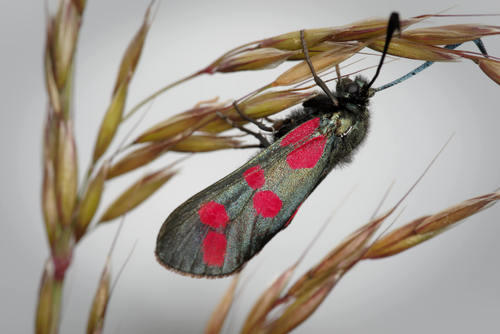
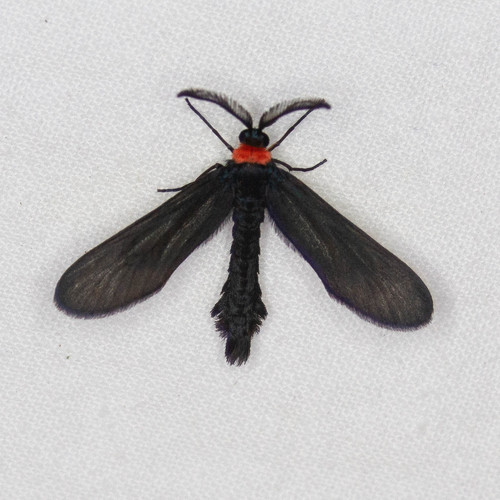
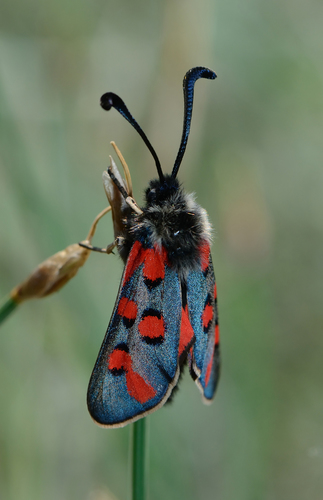
Zygaena lonicerae has a wingspan ranging from 30 to 46 millimetres (1.2–1.8 in). Female forewings measure 16–19 millimetres (0.63–0.75 in) in length, and male forewings are slightly smaller. The forewings are typically black with a strong bluish or blue-green sheen, and bear five spots in shades from crimson to vermilion. The third spot is smaller than the fourth. The head, thorax, and abdomen are black, and have a moderate to dense covering of hair. Antennae are long, slender, slightly club-shaped (clavate), and tapered toward the tip. Females resemble males, but have a slightly rounded forewing apex and less hair on the abdomen and thorax. This species is highly variable overall: populations from alpine areas are usually much larger, while populations from southern Europe are typically darker. This species is distributed across most of Europe, from Ireland to Fennoscandia, and extends eastward to western China. In southern Europe, it is widespread from northern and central Spain to Turkey and the Caucasus. In western Europe, it favours dry to mesophilic habitats including coastal areas, sea-cliffs, open forests, grassland, chalk downland, and subalpine valleys, occurring up to an elevation of 2,000 metres (6,600 ft) above sea level. This day-flying moth is active from June to early August, depending on location. It feeds on nectar, and prefers blue-violet flowers; common nectar sources include Knautia arvensis (field scabious), Scabiosa columbaria (dove pincushion flower), Centaurea jacea (meadow knapweed), Centaurea stoebe (panicle knapweed), Cirsium arvense (creeping thistle), Cirsium tuberosum (bulbous thistle), and species in the genus Carduus (ring thistle). Females lay pale yellow eggs in July on the undersides of host plant leaves, or on plants growing close to host plants. Fully developed caterpillars reach 19 to 28 millimetres in length. Their colour is bluish green or pale yellow, they bear long pale hairs, and have several rows of nearly rectangular black spots. Larvae feed on a variety of low-growing plants, including multiple Trifolium species (Trifolium medium, Trifolium montanum, Trifolium pratense, Trifolium repens), multiple Lathyrus species (Lathyrus pratensis, Lathyrus linifolius, Lathyrus sativus), plus Vicia species, Lotus corniculatus, Lotus uliginosus, and Onobrychis viciifolia. Larvae and pupae are occasionally parasitized by the tachinid fly Phryxe magnicornis and some species of wasps. Larvae feed until late summer or early winter, and resume development the following year. Fully grown caterpillars are ready by the end of May; underdeveloped caterpillars overwinter a second time. Caterpillars pupate inside an elongated, spindle-shaped yellowish or white cocoon attached to grasses or other plants. Pupae range in colour from brown to black.