About Zygaena hilaris Ochsenheimer, 1808
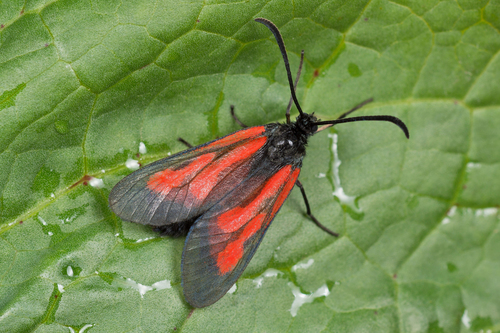
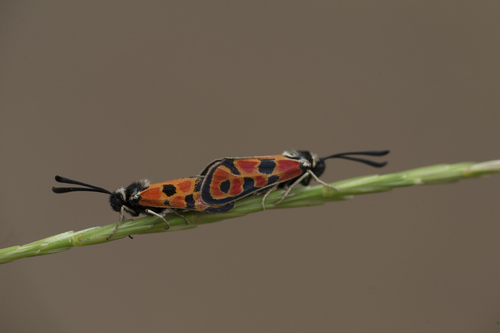
Zygaena hilaris Ochsenheimer, 1808 is a moth species with a wingspan of 24–25 millimetres (0.94–0.98 in). These moths are polymorphous. Their forewings have a black base with five large red stains that are usually joined together, and these stains are often surrounded by ocher-orange rings. The hindwings are entirely red with a thin black line along the outer edge. The body is black, with the exception of a faintly marked ocher prothoracic necklace. The caterpillars are hairy, greenish-yellow with rows of small black spots. This species is quite similar to Zygaena fausta, which has an abdominal ring. In technical description, Zygaena hilaris Ochs. (7i) is as small as, or even smaller than, Zygaena formosa. The red color is so dominant that it covers the entire forewing, leaving only small black dots. These black dots are sometimes confluent, but are often reduced to widely separated dots. A red collar is never present, though yellowish white hairs may sometimes appear on the edge of the thorax. A pale yellow aberration from Digne, Basses Alpes, held by the Tring Museum is labeled as pallida (Zygaena hilaris ssp. chrysophaea Le Charles, [1934]), but the author does not consider it necessary to name such pale yellow aberrations here if they have not already received names. In the subspecies Z. hilaris ssp. ononidis Millière, 1878 from the French Riviera, the red spots are not separated from the black ground by yellowish white borders. In Zygaena hilaris ssp. escorialensis Oberthür, 1884 (7k) from the Castilian table-land, the wings are more thinly scaled, pale rosy, and the black spots are reduced to thinly pale-edged dots. Aberration ab. bicolor Oberth. (now classified as Zygaena hilaris ssp. galliae Oberthür, 1910) (7k) has no black markings, only light dots that are remnants of the edging. Finally, ab. unicolor Oberth. (also classified as Zygaena hilaris ssp. galliae Oberthür, 1910) (7k) has uniformly red wings with a narrow black border. The larva is very short and thick, yellow, greenish on the anterior end, with dorso-lateral rows of thick black dots, and a brown head. It can be found on Ononis in June. The pupa is brown, enclosed in a yellowish grey or brownish wrinkly cocoon. Adult moths fly mostly in the morning until 11 o'clock, and again in the afternoon starting at 4 o'clock. They inhabit dry sunny hills and cornfields located between mountains, always flying quite low only around 20 cm above the ground, and prefer to rest on clusters of Thyme. This species varies strongly; Oberthur recorded additional aberrations with coffee-brown wings besides the forms mentioned above. This species is distributed in France, Spain, Portugal and Italy. It inhabits dry meadows, edges of calcareous grasslands, dry shrubland, sunny slopes and clearings in dry forests, occurring from sea level up to 2000 meters. It is common along the Riviera and the South-East Coast of Spain, and has also been recorded from Digne in the Basses Alpes.