About Zygaena filipendulae (Linnaeus, 1758)
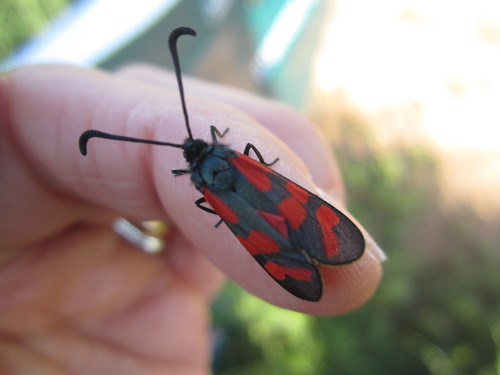
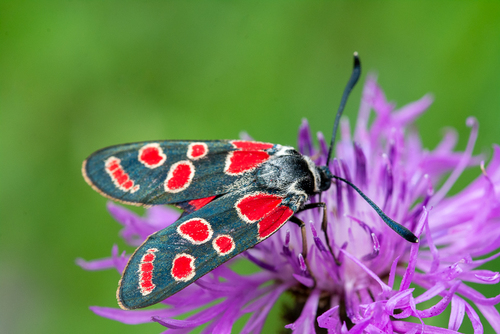
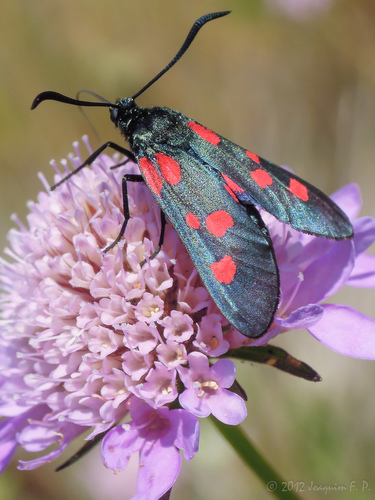
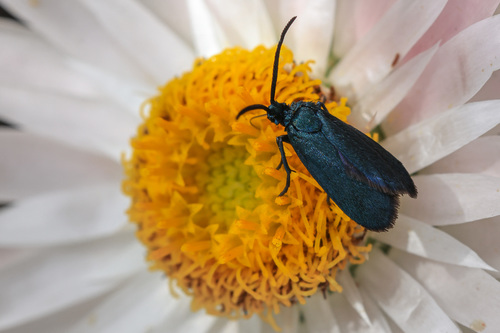
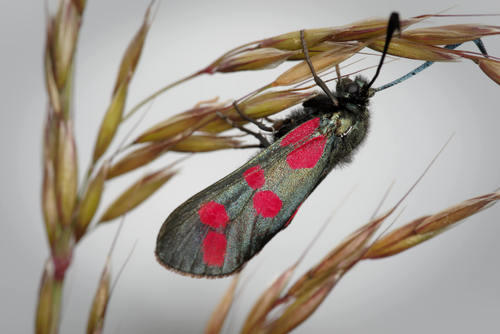
Zygaena filipendulae (Linnaeus, 1758) has a wingspan of 30–40 mm (1.2–1.6 in), and males and females are similar in appearance. Its fore wings are dark metallic green with six bright red spots; sometimes these spots merge, which can cause confusion with other species like the five-spot burnet. Rarely, the spots may be yellow or even black. The hind wings are red with a blackish fringe. The larva is plump and hairy, with variable markings; it is usually pale green with rows of black spots. This is an aposematic moth: its bright coloration signals to predators such as birds and lizards that it is toxic. If attacked, the moth emits a cyanide-containing liquid, and cyanide is present in all life stages of the species. Zygaena filipendulae is a common species across most of Europe; it is absent from the Atlantic coast of the Iberian Peninsula, northern Scandinavia, and the Great Russian North. It also occurs in Asia, ranging from Anatolia through the Caucasus to Syria and Lebanon. This species inhabits meadows, woodland clearings, sea-cliffs, and areas with abundant grasses and flowers, and can be found at altitudes up to 2,000 metres (6,600 ft).