About Zygaena exulans (Hohenwarth, 1792)
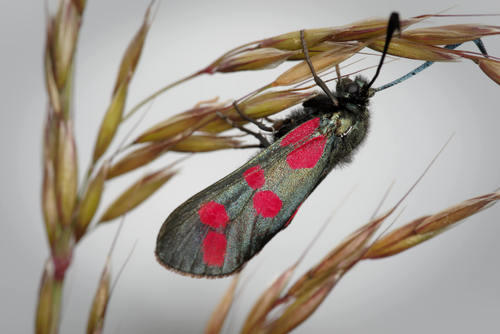
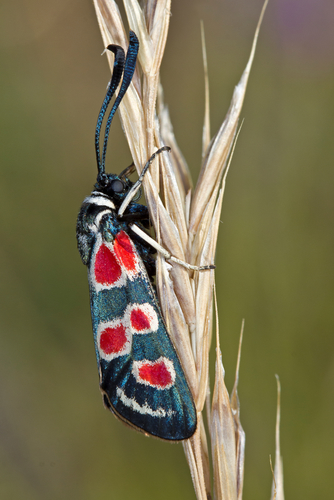
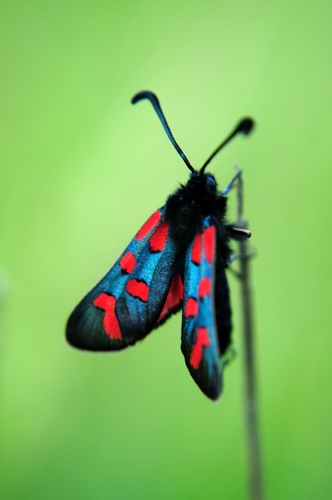
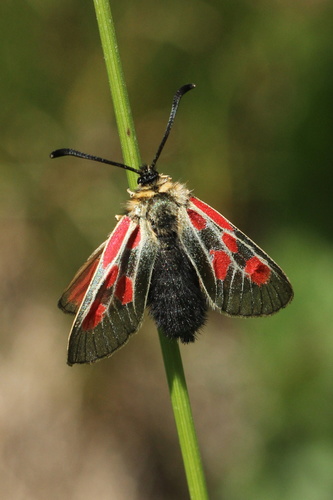
Zygaena exulans, also known as the mountain burnet moth, has a wingspan ranging from 25–33 millimetres (0.98–1.30 in). Its body is covered in dense hair. Male forewings are black-gray, while female forewings are matt gray, almost translucent, and marked with a metallic sheen. Both sexes have four distinct red spots plus an elongated red stain at the base of the forewings. The red marking at the wing root is wedge-shaped, and the other red spots are oval or round. The hindwings are red with a gray outer edge and black fringes. The antennae are club-shaped. This moth has aposematic coloration, and when attacked by predators such as birds and lizards, it releases a cyanide-containing liquid. It is quite similar in appearance to Zygaena lonicerae, Zygaena loti, and Zygaena purpuralis. The eggs of this species are pale yellow, relatively large, and oval-shaped. Fully grown caterpillars reach a length of approximately 20 millimetres (0.79 in). They are velvety black, with yellowish markings on every segment, and covered in short white hair. The pupa is brown-black and develops inside a thin, gray-white cocoon. This species occurs in mountainous regions of southern Europe, including the Alps, Pyrenees, Apennines, and Balkans, at elevations between 1,800–3,000 metres (5,900–9,800 ft) above sea level. It is also found in Scotland, Scandinavia, and northern Russia. These moths live in mountain lawns and northern moors.