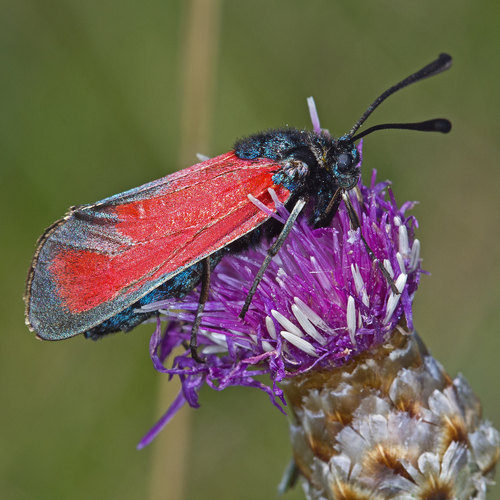
About Zygaena erythrus Hübner
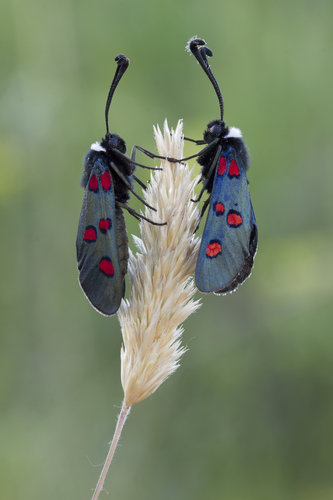
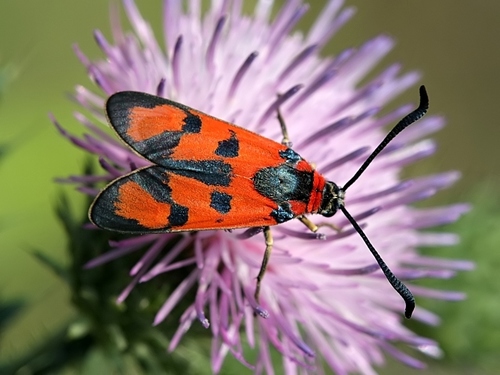
Zygaena erythrus has a wingspan of 25–33 mm. These relatively large moths have enlarged, confluent red spots on their forewings, with black surrounding these spots in the distal portion of the wing. Females are slightly larger than males, and have a yellow golden dusting with less defined markings. Mature larvae are rather dark greyish, with two series of black dorsal spots. This species is very similar to Zygaena purpuralis, but differs in that it has red scales in the axillary area of the forewings, covering up to one third of the forewing length. In Seitz's technical description and variation, Z. erythrus Hbn. (= saportae Boisd.; minos Boisd.) (4a) is larger, with a longer antenna that has a thicker club. The red color on the forewing is restricted to 3 streaks, with the distal streak having a wedge shape; additionally, only the basal third of the forewing's hindmargin is red. It occurs in southern France, Italy and Sicily. In the aberration irpina Zickert, found in the Riviera, the cuneiform spots are confluent. The form magna (Seitz, [1907]) (4a), a very large form from the Abruzzi, is sold by Staudinger; its posterior cuneiform spot is strongly widened and straight-truncate at the distal end. The larva is dull greenish yellow, with large black subdorsal dots and yellow side-spots (Sapokta); in some districts it cannot be distinguished from the larva of Zygaena purpuralis. Larvae feed on Eryngium and Thyme (Rouast). The species overwinters in the larval stage, with pupation occurring at the end of May. Adult moths emerge in June and July, and frequently rest on Thyme and Eryngium. This endangered species is only found in France and Italy. It prefers dry, rocky areas with sparse vegetation and a limestone substrate, but also occurs in heathlands, nutrient-poor grasslands, and wide verges in oak forests that host its Eryngium host plants. It can be found from sea level up to over 1,500 metres (4,900 ft).