About Zygaena ephialtes (Linnaeus, 1767)
Zygaena ephialtes (Linnaeus, 1767) is a member of the Zygaenidae moth family. Adults of this species typically fly during the day, and their flight is characteristically slow. Like other Zygaenidae moths, they have prominent wing spots that act as a warning signal to predators that the moths contain toxins.
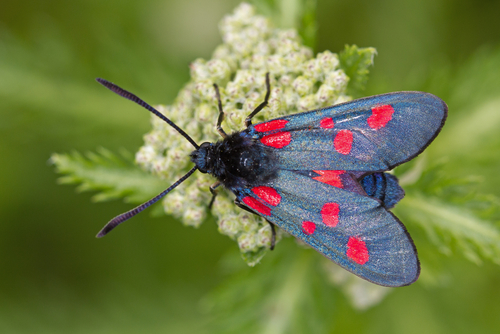
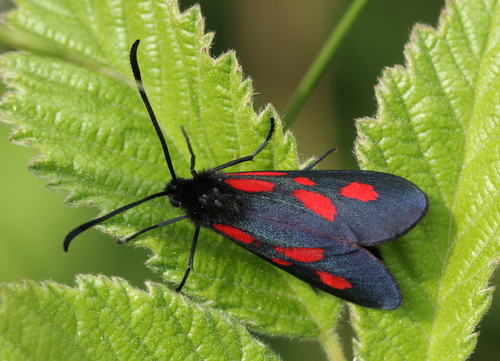
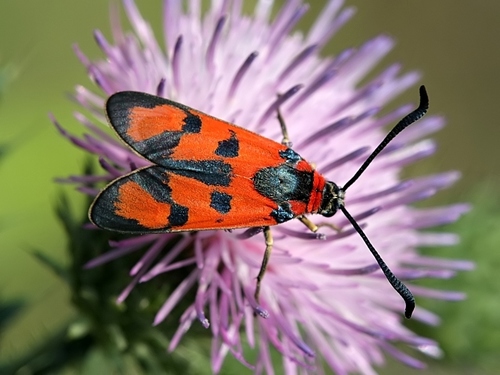
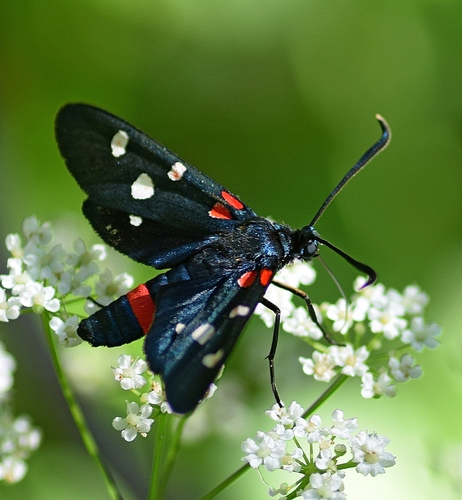
In technical terms, the nominal Z. ephialtes L. (= falcatae Boisd.) has 6 spots on its forewing: the basal pair is red, and the remaining spots are white. The hindwing has a single white dot, and the abdomen has a red belt. This form is recorded from South Germany and Switzerland, eastwards to Greece and South Siberia, though this range record is marked as doubtful, possibly resulting from misidentification.
The subspecies Zygaena ephialtes medusa Pallas, 1771 (formerly medusa Pall.) is a form that lacks the 6th forewing spot, and it is especially common in the eastern portion of the species' range. In the western portion of the range, particularly Northern Italy, South Germany, Austria, and some Balkan states, there are two forms that share the patterning of Z. ephialtes ssp. medusa, but have deep yellow rather than red basal forewing spots and abdominal belt. These are Z. ephialtes ssp. coronillae (Denis & Schiffermüller, 1775) (formerly coronillae Esp.), which has 6 forewing spots, and Z. ephialtes ssp. coronillae (formerly trigonellae Esp.), which has 5 forewing spots.
In Austria, two varieties that often occur alongside other forms at the same sites have yellow forewing spots and entirely yellow hindwings except for a black margin. These are also classified as Z. ephialtes ssp. coronillae (Denis & Schiffermüller, 1775): icterica Led., which has 6 forewing spots, and aeacus Esp., which has 5 forewing spots. In some cases, the yellow color has a strong reddish tint: 6-spotted forms of this type are called princi Hirschke, while 5-spotted forms are called aurantiaca.
Red forms of Z. ephialtes that resemble red-belted Z. filipendulae or Z. trifolii ab. orobi are the species' most northern forms. These are Z. ephialtes ssp. peucedani Esper, 1780 (formerly peucedani Esp. = hippocrepidis H.-Sch.; aeacus Hubn.), which has 6 spots, and Z. ephialtes ssp. athamanthae Esper, 1789 (formerly athamanthae Esp. = veronicae Bkh.), which has 5 spots. In these forms, the red color of the hindwing can be increasingly overtaken by the black marginal band, ending with only a small red central spot remaining. 6-spotted forms of this variant are ab. guenneri Hirschke, and 5-spotted forms are ab. metzgeri Hirschke, both now classified as Z. ephialtes ssp. coronillae (Denis & Schiffermüller, 1775).
There is also a group of aberrations where the hindwing has two small spots instead of a single white or red spot. This modification occurs in nearly all the forms mentioned above, and each variant has been given a separate name: 2-spotted hindwing nominal Z. ephialtes is named sophiae Favre, the equivalent 2-spotted form of medusa is aemilii Favre, 2-spotted coronillae (6-spotted forewing) is bahri Hirschke, and the equivalent 2-spotted form of 5-spotted forewing trigonellae is wutzdorffi Hirschke.
The larva is yellow or green, with reddish-yellow sides and pale belts. It has a black dorsal stripe, black subdorsal rows of spots, and rows of black dots above the legs. It is overall similar in appearance to the larva of Z. filipendulae. Mature larvae are found in May on Vetch, Trefoil, Thyme, Eryngium, Plantago, and other host plants. The black pupa develops inside a white-yellow silky cocoon.
Adult imagos fly in July, in meadows, and will even venture into gardens. They are particularly common resting on thistle heads near woodland edges and on fallow ground. Sometimes only one form occurs at a given site, while at other sites multiple forms fly together in the same field and copulate with each other, but their offspring do not show mixed or transitional characters. Occasionally, Z. ephialtes individuals have been observed mating with individuals of completely different species.
This moth is distributed across most of Europe, ranging from Spain to the Ural Mountains. It is absent from the British Isles, northern Europe, and certain Mediterranean islands.
A study by Jakub Horak focused on Z. ephialtes populations in the Czech Republic revealed many previously unknown habitat preferences for the species. Z. ephialtes cannot survive in forested areas or areas with a closed canopy. It prefers xeric conditions, and is rarely found in more humid areas. The only two recorded occurrences in non-xeric areas were at sites that were previously xeric and had been abandoned. The xeric study sites also hosted many xeric specialist species specifically associated with dry environments, including Phengaris arion, Psophus stridulus, Polyommatus coridon, Polyommatus daphnis, Plebjus argus, and Zygaena carniolica. The study confirmed that Z. ephialtes is an important component of xeric habitats.