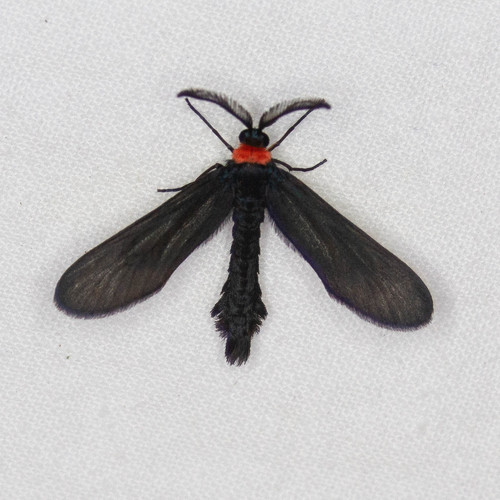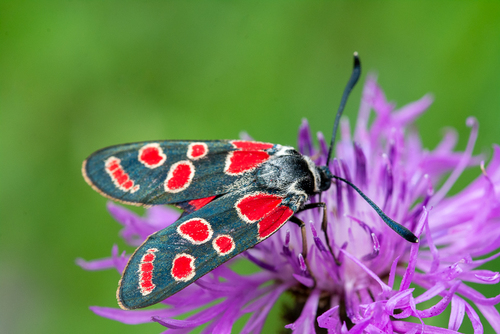
About Zygaena carniolica (Scopoli, 1763)
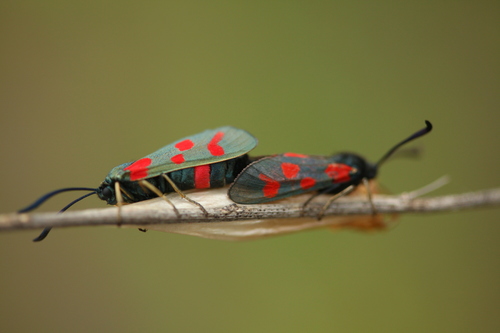
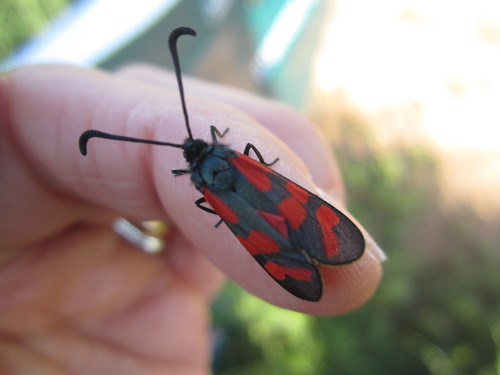
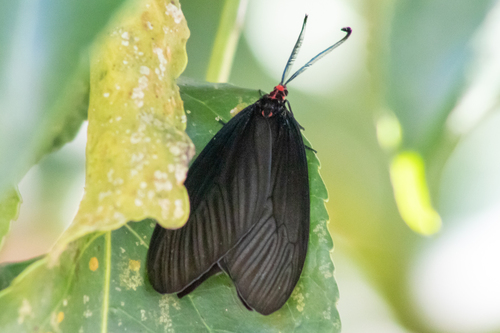
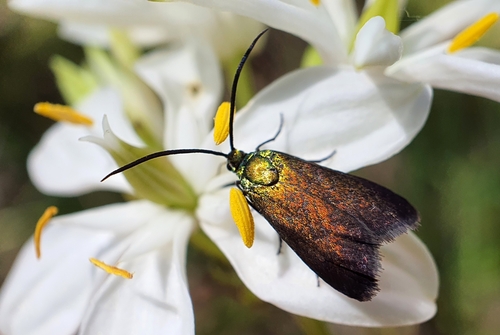
Zygaena carniolica (Scopoli, 1763) has a wingspan of 30–35 mm. Its forewings are bluish-black with six red spots surrounded by yellow; outer spots are often crescent-shaped. The hindwings are red with a black border. The abdomen is black-blue, and sometimes bears a red belt. The light green caterpillar has a series of triangular black spots along its body sides. Pupae are black-brown, contained within a white or yellowish ovoid cocoon. This species is quite similar to Zygaena algira, Zygaena maroccana, Zygaena occitanica, Zygaena orana and Zygaena youngi. More than 20 named forms are grouped under this species, making it difficult to provide a single general description of its colour and pattern. The antenna is robust, enlarged into a stout club. The collar and edge of the thorax are mostly covered in whitish hairs, and the legs are black-blue with yellow undersides. The forewing is metallic black-green, densely scaled, with light reddish yellow fringes; it bears 6 spots, with the sixth being halfmoon-shaped and parallel to the distal margin. Even when the normal spot colour is absent in rare specimens, the species can still be identified by the distinct gloss of its scaling. This species is distributed across Central and South Europe, North Africa, and Western Asia, with its range extending to Turkestan and the Altai. Below are descriptions of the named forms and variations of Zygaena carniolica. The name-typical form, carniolica Scop. (= onobrychis Schiff. & Den., caffer Esp. (8d), has white-edged forewing spots and a red abdominal belt. It occurs from Central Germany southward to the Mediterranean, and eastward to the Altai. Aberration flaveola Esp. (= luteola Boisd.) [Zygaena carniolica ssp. flaveola Esper, 1786 ] (8d) has straw-yellow hindwings and forewing spots instead of red. It occurs rarely alongside the typical form across most of its range, and is especially common in Austria. Aberration dichroma Hirshke has red colouration mixed with yellow. In aberration grossi Hirshke (now a junior synonym of Z. carniolica Scopoli, 1763), red is replaced by coffee-brown. Subspecies hedysari Hbn. (= astragali Hbn., onobrychis Boisd., meliloti Hbn., sedi Dup.) [Zygaena carniolica ssp. hedysari Hübner, 1796] (8e) lacks a red abdominal belt; it is the most common form in Germany, and is also locally dominant in Italy and other countries. Subspecies diniensis H.-Sch. [Zygaena carniolica ssp. diniensis Herrich-Schäffer, 1852] (8e) has a red abdominal belt, with very large, fiery red forewing spots that have very thin light borders. It is found on the French Riviera. In bohatschi Wagn. (now a junior synonym of Z. carniolica Scopoli, 1763), the forewing spots are confluent in pairs; it occurs in Liguria. In aberration jurassica Blachier (now Zygaena carniolica ssp. virginea Müller, 1766), the central spots are very large and connected to the red basal area by a costal streak, while the sixth spot remains isolated. It is found near Geneva in July and August. Aberration weileri Stgr. (= diniensis Oberth.) (now Zygaena carniolica ssp. modesta Burgeff, 1914) has proximal spots merged into a large red patch that bears single red dots, with only the sixth (lunate) spot remaining separate. It occurs in Germany, Austria and the Riviera. Aberration ragonoti Gianelli (8f) (now Zygaena carniolica ssp. virginea Müller, 1766 ), from Turin, is only a modified form of weileri; its forewing is almost entirely red, but in addition to the isolated sixth spot, it has more black markings in the forewing basal area than weileri. An entirely red-winged aberration from Hungary held in the Tring Museum has been named totirubra ab. nov. (now a junior synonym of Zygaena carniolica Scopoli, 1763) (8f), matching how corresponding forms of other Zygaena species have been named. In amoena Stgr. (now a junior synonym of Zygaena carniolica Scopoli, 1763) (8ef), from Hungary and Lower Austria, the whitish edges of the forewing spots are so enlarged that white almost completely displaces the dark ground colour; the hindwing is sometimes pale pink, as seen in the third specimen of amoena figured at 8f. In berolinensis Stgr. [Zygaena carniolica ssp. berolinensis Lederer, 1853] (8g), which occurs singly alongside the normal form across the range and is especially typical of the Italian Riviera, the white margins of the forewing spots are completely absent, and the abdomen has no red belt. Subspecies taurica Stgr. [Zygaena carniolica ssp. taurica Staudinger, 1879] (8g) is a Lydian form where the proximal spots have broad white edges, and the sixth transverse spot is almost gone. In apenina Tur. (= wiskotti Calb.) (now Z. carniolica ssp. hedysari Hübner, 1796) (8g), which is not rare near Genoa behind Campo Santo among hedysari and berolinensis forms, the sixth transverse spot is completely absent or only visible as a faint shadow in the ground colour. Subspecies graeca Stgr. [Zygaena carniolica ssp. graeca Staudinger, 1870] is a small form that resembles the name-typical carniolica, and shares its red abdominal belt, but the whitish yellow edges of its forewing spots are much thinner. It is found in Greece. Subspecies amasina Stgr. (8j) [Zygaena carniolica ssp. amasina Staudinger, 1879], from Asia Minor, closely resembles amoena, but has bright clean red colouration instead of pink, and retains abundant traces of the black ground colour that is almost entirely replaced by white in amoena. Subspecies wiedemanni Men. [Zygaena carniolica ssp. wiedemannii Ménétriés, 1839] (8h), from Anterior Asia, on the contrary has so much white on the forewing that white is the dominant colour; additionally, the abdomen is vermilion except for its base and tip. Subspecies albarracina Stgr. [Zygaena carniolica ssp. albarracina Staudinger, 1887], from Andalusia, is a small form that approaches Z. orana, but has less red on the abdomen. In subspecies transiens Stgr. [Zygaena carniolica ssp. transiens Staudinger, 1887], the sixth spot (which is white-edged in previously described forms) is entirely white, with its red centre having disappeared. This form approaches the Z. occitanica group, which multiple authors have attempted to separate as a distinct species from Z. carniolica forms from Western Asia. In current distribution records, this species occurs across most of Europe, absent from the British Isles and northern Scandinavia. It is also present from Asia Minor to Iran. It inhabits warm, dry areas including grasslands on limestone substrate, steppe slopes, and dry pastures.