About Zosterops palpebrosus (Temminck, 1824)
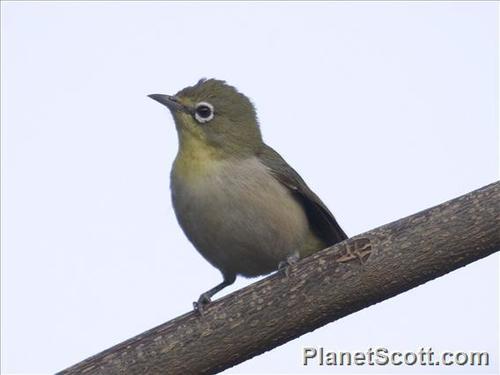
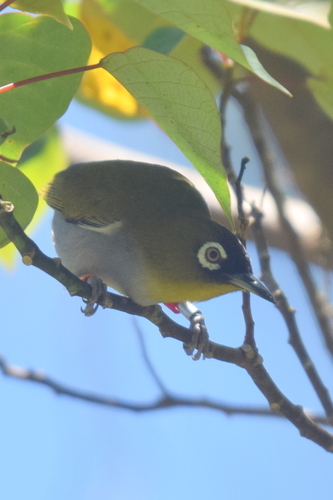
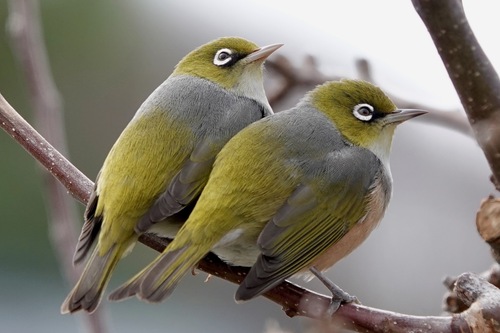
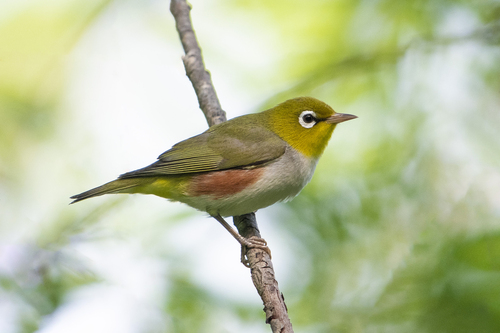
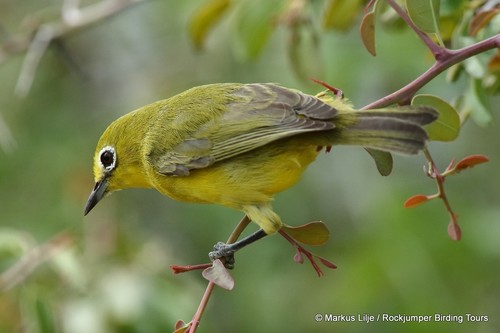
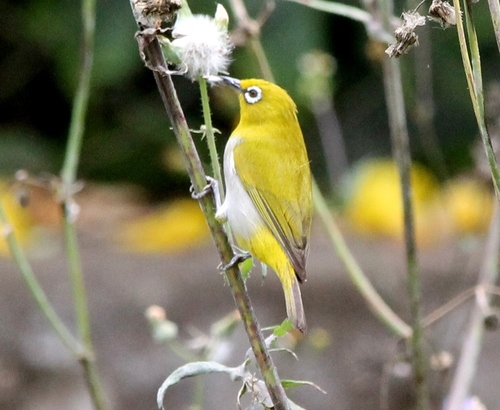
This small bird measures about 8–9 cm in length. It has yellowish olive upperparts, a distinct white eye ring, a yellow throat, and a yellow vent. Its belly is whitish-grey, though some subspecies may have yellow bellies, and males and females look identical. The species is widespread and is part of a superspecies complex that includes Zosterops japonicus, Zosterops meyeni, and potentially other species. The taxonomy of this group remains unclear: some island populations are considered distinct, while other proposed splits lack strong supporting evidence. For example, the population from Flores, Indonesia, is found to be more closely related to the pale white-eye. The placement of the family itself is currently questioned, as genetic data place it nested alongside Stachyris babblers. About eleven subspecies are widely recognized. The nominate subspecies, with a type locality in Bengal, India, occurs from Oman and Arabia through Afghanistan, northern India, and into China and northern Myanmar. Populations in the Western Ghats and hills of southern India are placed in the subspecies nilgiriensis. By contrast, salimalii from the hills of the Eastern Ghats (including the Shevaroy, Chitteri, Seshachalam, and Nallamalai hills) is sometimes grouped into the nominate subspecies. Populations from the plains of India, Laccadives, and Sri Lanka are sometimes classified as egregius (alternatively spelled egregia), though other authorities restrict egregius to only the Sri Lankan population. Populations in southern Myanmar, Thailand, and Laos are classified as siamensis. The form from the Nicobar Islands is called nicobaricus, and this name is sometimes also applied to the Andaman Islands population; the Andaman population is actually a distinct, still unnamed group. Populations from southern Thailand to western Cambodia are placed in williamsoni. Other Southeast Asian island subspecies include auriventer (alternatively aureiventer), buxtoni, melanurus, and unicus. The Western Himalayan race occidentis, now often included in the nominate subspecies, has dark green upperparts and brown-tinged flanks. The subspecies salimalii has a shorter bill and brighter yellow-green upperparts. Some authors restrict the nominate subspecies only to Sikkim, Bhutan, Assam, and Yunnan, and classify the peninsular Indian population as occidentis (or amabilis if Koelz's Kathiawar form is considered valid). In Sri Lanka, the subspecies egregia is smaller and has a brighter back and throat than the endemic Sri Lanka white-eye, Zosterops ceylonensis, which is found in Sri Lanka's central hills. The species occurs across a wide range of habitats, from scrub to moist forest. It sometimes occurs in mangrove areas, such as in the Karachi region of Pakistan. On islands, individuals may have a more insectivorous diet. It is only somewhat rare in the drier desert regions of western India. A feral population was detected in San Diego, California, in the 1980s, and was subsequently eradicated. These white-eyes are social, and form flocks that only separate when the breeding season approaches. They are highly arboreal, and only rarely come down to the ground. The breeding season runs from February to September, with a peak in April. They build a compact cup nest that is suspended like a hammock from the fork of a branch. The nest is constructed from cobwebs, lichens, and plant fibre, and takes about 4 days to build. The clutch consists of two pale blue eggs, laid a couple of days apart. The eggs hatch after around 10 days of incubation. Both sexes participate in brooding the chicks, which fledge about 10 days after hatching. Though the Indian white-eye is mainly insectivorous, it also feeds on nectar and a variety of fruits. It calls frequently while foraging, and its typical contact call is a soft nasal cheer. When visiting flowers to feed on flower-dwelling insects such as thrips, and possibly nectar (a dietary role that is questioned), the species acts as a pollinator. Pollen sometimes colors the bird's forehead, which has led to mistaken identification of specimens. Individuals have been observed bathing in dew that has accumulated on leaves. When nesting, they may mob palm squirrels, but as small birds, they are usually on the defensive. Their predators include the greater false vampire bat (Megaderma lyra) and birds such as the white-throated kingfisher. Endoparasitic Haemosporidia from the genera Haemoproteus and Dorisa have been isolated from this species, though these parasites rarely cause death. Like some other white-eyes, they sometimes steal nesting material from the nests of other bird species. Cases of interspecific feeding have been recorded, where Indian white-eyes have fed the chicks of a paradise flycatcher. Although they are not strong fliers, they can be carried by winds and storms to new areas, including offshore islands. A feral population of this species became established in California during the 1980s, requiring targeted capture and eradication. The birds were captured by luring them with call playback and live decoys into mist nets.