About Zosterops maderaspatanus (Linnaeus, 1766)
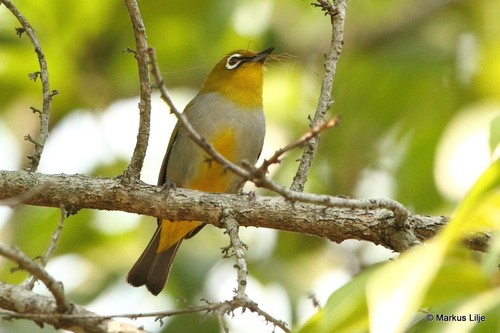
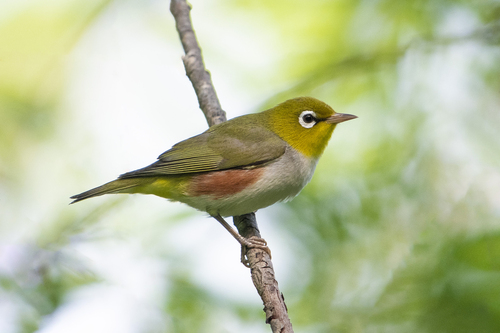
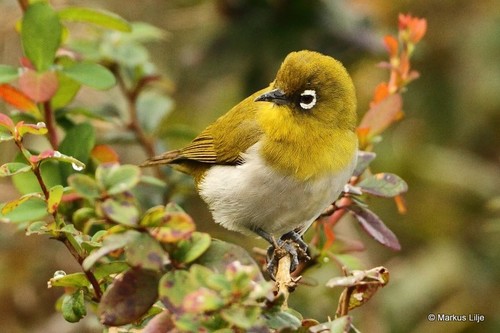
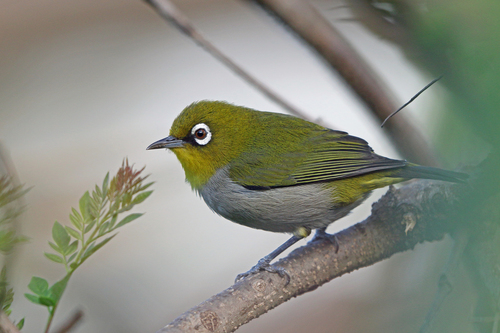
This white-eye species reaches an approximate length of 10 cm (4 in). Its upperparts, wings, and tail are dark olive green; its throat is yellow, and its breast and belly are pale grey. It has an incomplete white eye ring, with a gap at the front of its reddish-brown eye. The upper mandible of its beak is black, while the lower mandible is grey, and its legs and feet are greyish-blue. The Malagasy white-eye is distributed across Madagascar and the Seychelles. Small groups live in woodland, where they forage among branches, flit between trees, and constantly communicate with one another via a soft "pee-u" call. It is a lively, agile bird; its flight is strong but jerky, and each flight only covers a short distance. It feeds in open areas during the day, and moves deeper into the forest to roost at night. It enjoys bathing in pools, and also uses water trapped in tree hollows for bathing. Mutual preening occasionally occurs, with two birds leaning against one another while preening each other's head, face, and chin. Its diet is primarily made up of invertebrates and fruits, and also includes nectar, pollen, flower buds, and other plant matter. It finds insects by gleaning them from twigs and branches, and will sometimes cling upside-down to tree trunks to forage. It sometimes catches prey mid-air through hawking, may hover briefly while taking food, and probes into inflorescences and lichens, occasionally getting pollen dusted onto its body. Breeding occurs during the austral summer. The nest is a cup-shaped structure, either hung from a branch fork or built in the center of a bush. It is constructed from grass stems, flower heads, fine rootlets, slender fibres, hairs, and moss, and a clutch contains two to three eggs.