About Zosterops japonicus Temminck & Schlegel, 1845
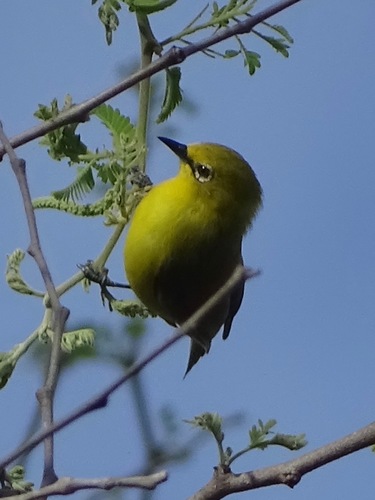
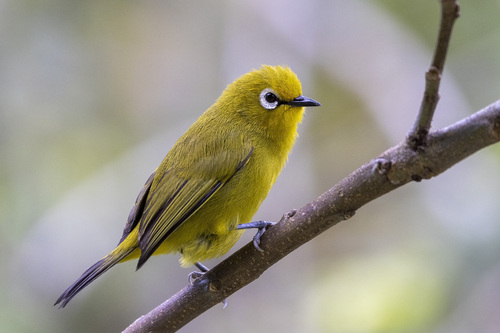
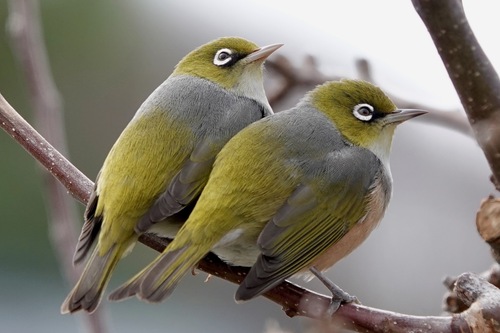
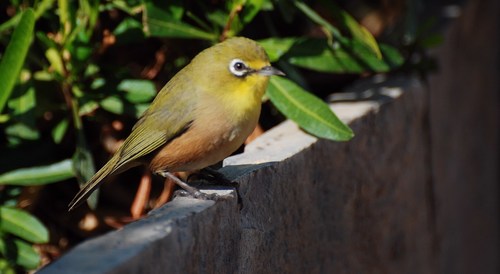
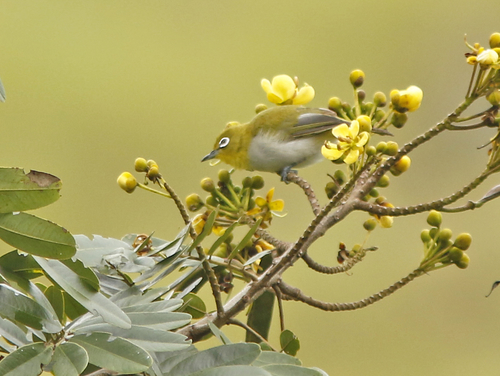
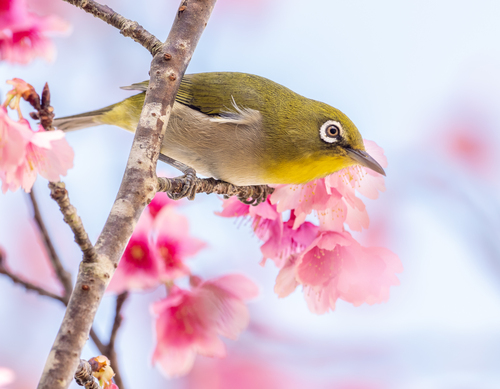
Description: The warbling white‑eye, also called Japanese white‑eye, has an olive green back from front to rear, and pale green on its underside. Its feet, legs, and bill vary in color from black to brown. It has a green forehead and a yellow throat. This species has rounded wings and a long, slender bill, traits that indicate it is a very acrobatic bird. Its wings are dark brown, with green edging along their outlines. Like other white‑eye species, the warbling white‑eye has the distinctive white eyering that gives the group and species its common name; in Japan, this bird is called mejiro, which translates to "white eye". Adult individuals are 10 to 11 cm (4 to 4.5 inches) long, and weigh between 9.75 and 12.75 grams. Distribution: The warbling white‑eye occurs naturally in Japan, Korea, Taiwan, eastern China, and the northern Philippines. Migratory populations of this bird spend the winter in Burma, Thailand, Hainan Island, and Vietnam. It is widespread and common across Japan, where it is counted as one of the more dominant bird species. In spring 2018, multiple sightings of what were thought to be Japanese white‑eyes were recorded in Southern California, with confirmed breeding documented in San Diego County by 2019. However, in 2019 these California birds were reclassified as part of the newly separated species Swinhoe's white‑eye. The dominant white‑eye population originally classified as warbling white‑eye in Taiwan has also been reassigned to Swinhoe's white‑eye.