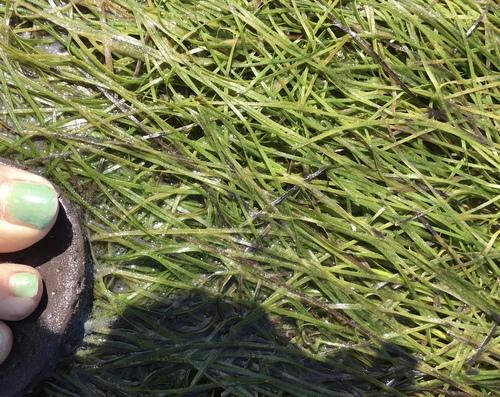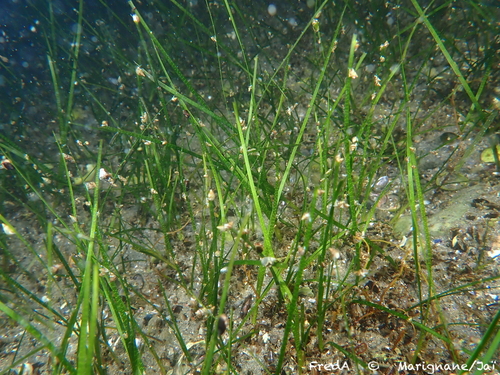
About Zostera noltii Hornem.
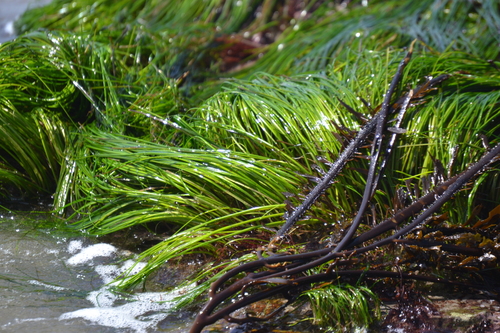
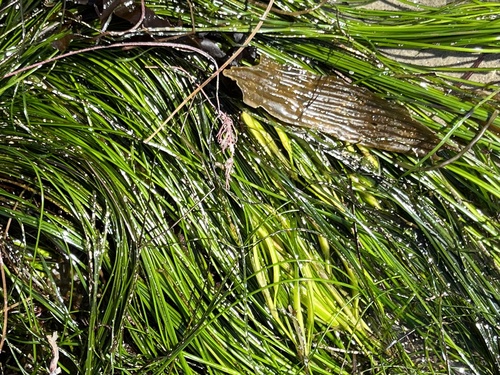
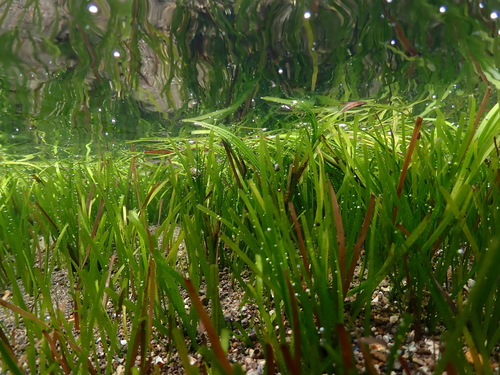
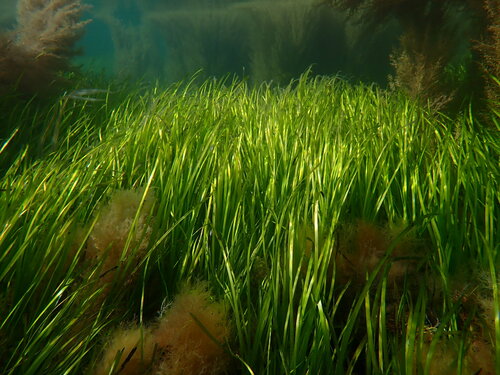
Zostera noltii Hornem. has a creeping rhizome that grows beneath the seabed surface. Groups of two to five strap-shaped leaves emerge from nodes on the rhizome; each node also produces a tuft of up to four short roots that anchor the plant into sediment. The leaves have three irregular longitudinal veins and blunt, notched ends. They reach up to 22 cm (9 in) long, and contain air spaces that give them buoyancy. Several separate male and female flowers grow on a short, spear-shaped lateral stem. Smooth white seeds develop inside a green capsule with membranous walls, and measure about 2 mm (0.08 in) long. This seagrass is found in the eastern Atlantic Ocean along European coasts, ranging as far north as Norway, Sweden and the Baltic Sea. Around the British Isles, it grows extensively in the Firths of Moray and Cromarty, the Wash, and the Thames Estuary. In Ireland, large populations occur in Strangford Lough, Dungarvan Harbour and Dublin Bay. In the Mediterranean and Black Seas, it is restricted to brackish conditions in lagoons and estuaries. It is the only seagrass species recorded in the Caspian Sea and the Aral Sea. It also grows in Morocco, Mauritania, and the Canary Islands, with the southernmost known population located in Senegal's Saloum Delta. It grows intertidally on fine sandy or muddy substrates, and can tolerate a range of salinity levels. It typically forms a band higher up the beach than Zostera marina beds, and is often mixed with other seagrasses of the genus Ruppia. In low salinity or brackish estuarine and lagoon waters, it grows subtidally in deeper water. High nutrient levels and cloudy water have negative effects on this species. Seagrass beds are highly productive and form the foundation of important coastal ecosystems. Many different algae grow epiphytically on Zostera noltii. These include the brown algal species Cladosiphon zosterae, Halothrix lumbricalis, Leblondiella densa, Myrionema magnusii, and Punctaria crispata, which also grow on other seagrasses such as Zostera marina. The parasite Plasmodiophora bicaudata infects eelgrasses including Zostera noltii. It stops further growth between nodes, damages plant clumps by causing leaves to grow in dense tufts, and results in the condition known as wasting disease. Eelgrass beds provide shelter for many invertebrates and a safe habitat for developing juvenile fish. Detritus from decaying leaves in winter enriches the surrounding sediment. Decomposing tissues form the base of a food web; large numbers of protists live in the nearby water column, feeding on leached organic compounds and the bacteria that break down the plant tissues. Zostera noltii is an important part of the winter diet of whooper swans (Cygnus cygnus), mute swans (Cygnus olor), brent geese (Branta bernicla), and wigeon (Anas penelope). Overwintering brent goose populations in Europe have declined since wasting disease became established and reduced available eelgrass abundance; wigeon numbers have also declined. These waterfowl are shy, and only feed on Zostera noltii after lower beach seagrass beds are depleted. At least some eelgrass seeds germinate readily after passing through the gut of wildfowl, which allows the seeds to travel dozens of kilometres (miles) and helps the species expand its range. However, Zostera noltii seedlings are rarely encountered, and vegetative reproduction—where sections of rhizome break away from the parent plant—is likely the most common method of spread. Zostera noltii and other seagrasses play an important role in stabilising sediments, reducing wave energy, and may provide coastal protection against erosion. Despite this, the species is sensitive to being smothered by shifting sediment and has a low ability to recover after burial, which may be due to its relatively short leaves and absence of vertical rhizomes. It is regularly exposed on the foreshore at low tide, and is resistant to desiccation. While it supports a biodiverse community of animal species, animal numbers are higher in subtidal Zostera noltii beds. Although Zostera noltii populations may be slowly declining, the IUCN Red List of Threatened Species lists it as a species of least concern.