About Zoropsis spinimana (Dufour, 1820)
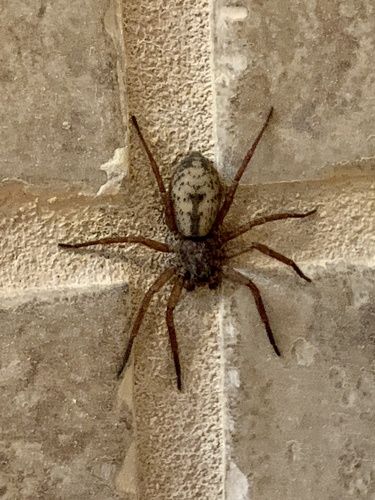
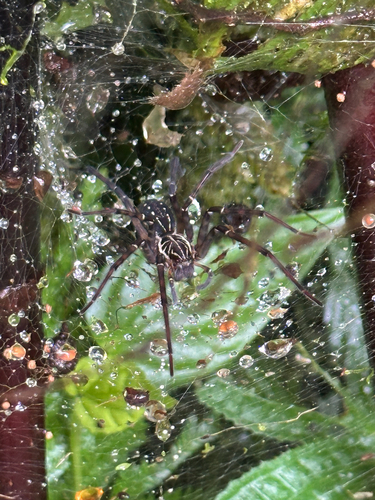
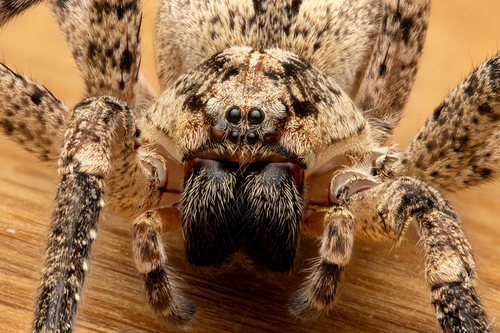
Male Zoropsis spinimana grow to around 10–12 mm (0.39–0.47 in) in length, while females reach 15–18 mm (0.59–0.71 in) long. This species resembles wolf spiders and shares the same eye configuration, but the eyes of Zoropsis spiders are more spread out along the front third of the cephalothorax. Its prosoma, the front body segment, is brownish with broad darker markings. The abdomen, also called the opisthosoma, has median black markings, and the legs are mostly a speckled brown color. The brown and light patterning on the upper side of the prosoma resembles the face of the vampire Nosferatu from the 1922 German silent film, which gave the species its common German name, Nosferatu-Spinne. Zoropsis spinimana is widely distributed across the Mediterranean region, and its range extends into Russia. It has been introduced to the United States, primarily in the San Francisco Bay Area, and to the United Kingdom, primarily in the London area. Since the mid-1990s, this species has been recorded along north-south transport routes in Europe, including locations such as Lucerne, Basel, Freiburg im Breisgau, Duisburg, Brussels, and Innsbruck. It remains unclear why this relatively large spider was not documented in these northern locations earlier, even though Mediterranean holidays in mobile homes were popular starting in the 1970s, which would have given the spiders ample transport opportunities and access to suitable new habitats. Ecologists hypothesize that climate change has allowed the spiders to establish and reproduce north of the Alps. A 2023 sighting in Copenhagen falls near what is currently believed to be the northern edge of the species' expanding distribution range. Zoropsis spinimana lives on forest edges, where it can be found under rocks and tree bark. It is a nocturnal hunter that does not build webs, like all other zoropsid spiders, and hunts prey freely. Because this species cannot survive harsh cold climates, it often shelters in human homes, where temperatures are milder and food is more abundant. Zoropsis spinimana reach sexual maturity in autumn. Females lay their eggs in spring, and remain resting in a brood chamber on the egg cocoon.