About Zoothera lunulata (Latham, 1802)
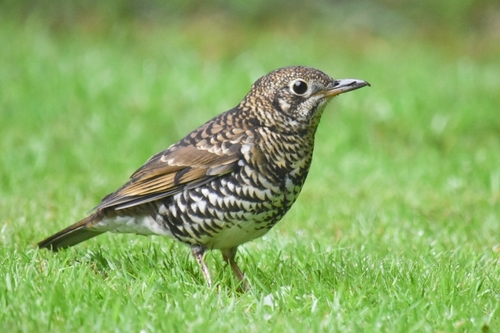
The Bassian thrush, whose scientific name is Zoothera lunulata, is also commonly called the olive-tailed thrush. It is a medium-sized thrush that feeds mostly on insects. Its distribution ranges from northern Queensland to southeastern Australia; it is also found in Tasmania, some larger islands of Bass Strait, and Kangaroo Island. Adult Bassian thrushes measure 27 to 29 cm (10.5 to 11.5 inches) in length, and have an average weight of 100 g (3.5 oz). While the total population across its entire range is estimated to be large, no official population count has ever been conducted. The population is thought to be slowly declining due to ongoing habitat destruction and degradation, but the rate of decline is not considered a cause for concern. Bassian thrushes inhabit shrubland, forests, and rainforests. They are generally considered resident species, but there is some evidence that some individuals show nomadic behavior, most often during the non-breeding season. Their plumage ranges in color from brown to olive, with a white ring around the eye and black bars on the back, rear of the body, and head. Their underbody is paler in color with dark scalloped markings, and a dark bar runs the full length of the underside of their wings. Nesting activity starts in winter, from late June, and continues through the end of summer. A typical clutch contains two or three eggs, which range in color from pale green or blue to light stone. The nest is cup-shaped, usually constructed from strips of bark, sometimes mixed with leaves, and lined with grasses and rootlets. Nests are placed at sites ranging from a few feet to 15 m (50 feet) above the ground. A tree fork is the most common nesting site, but nests may also be placed on a stump or on a ledge inside a cave. Bassian thrushes hunt by disturbing leaf litter to dislodge hidden prey. They move quietly and often pause to listen for moving insects.