About Zoosphaerium neptunus (Butler, 1872)
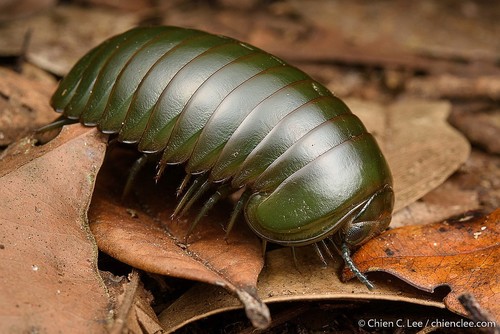
Zoosphaerium neptunus (Butler, 1872) is a large species of pill millipede that shows strong sexual size dimorphism. Males grow to approximately 45 mm (1.8 inches) in length, while females can reach up to 90 mm (3.5 inches) long. The species' tergites range in color from shiny light green to darker olive green; its head, antennae, and legs are also greenish. Each tergite has a narrow brown line along its posterior margin. Alcohol-preserved specimens may darken to a light brown color. Like other giant pill millipede species, adult Z. neptunus have twelve tergites and an anal shield. Each antenna has six joints, females have 21 pairs of legs, and males have 23 pairs of legs; the last two pairs of male legs are modified reproductive structures called telopods. The tergites of this species are smooth and hairless. The head bears more than 80 ocelli. The sixth antenna joint is the longest, and has a terminal disc that holds 18 to 26 sensory cones. The mandible has six rows of pectinate lamellae, and the ventral side of the gnathochilarium has numerous bristles. The collum, the first segment behind the head, has long isolated hairs along its anterior margin, and a row of more widely spaced isolated hairs along its posterior margin. Zoosphaerium neptunus is endemic to Madagascar, occurring mostly in the northern part of the island. It is one of the few widely distributed giant pill millipede species found on the island. This millipede inhabits rainforest environments, ranging from eastern lowland forest to mid-elevation forest up to 850 meters above sea level. Like other pill millipedes, Z. neptunus is a detritivore that feeds on decaying organic matter, particularly dead leaves. Its lifespan is three to four years. While giant pill millipedes are rarely found in large groups in Madagascar, Z. neptunus is known to form swarms that can include tens of thousands of individuals. These swarms can reach up to 1,100 meters in length and between three and ten meters in width. Within swarms, most millipedes walk slowly, all in the same direction, and appear to be unaware of their surroundings; some individuals even walk into water and drown. All millipedes in a single swarm are similar in size, but swarms can include both juveniles and mature adults. Researchers suspect swarming acts as a defense strategy that improves individual chances of surviving predation.

