About Zonitoides nitidus (O.F.Müller, 1774)
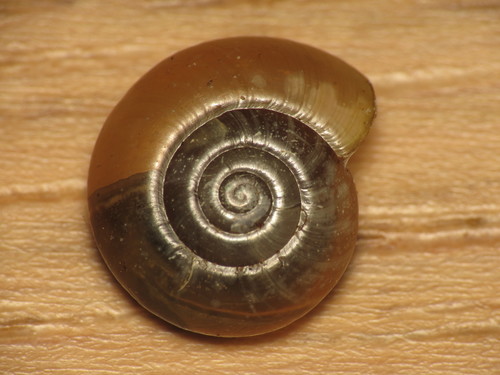
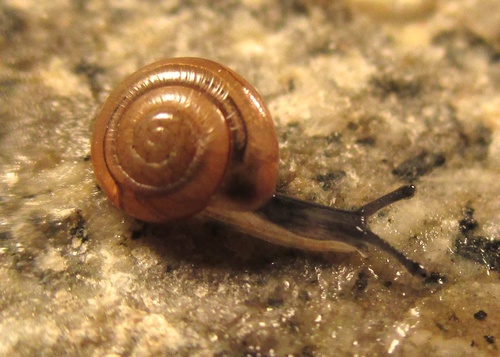
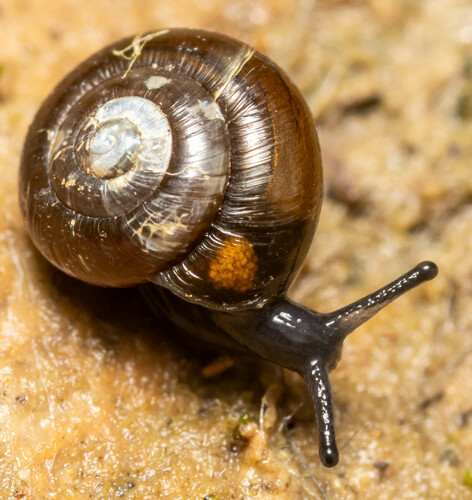
The shell of Zonitoides nitidus is reddish brown, with a large umbilicus that makes up almost 25% of the shell diameter. It has radial growth lines, and it is wider than it is tall. The shell measures 6–7 mm (0.24–0.28 in) wide and 3.5–4.0 mm (0.14–0.16 in) tall. The body of an adult Z. nitidus is black with an orange dash, and its mantle gland is visible under the aperture of the shell. Juveniles are whitish grey, with light brown translucent shells. Zonitoides nitidus has a Holarctic distribution. It occurs across most of Europe, excluding the southernmost regions. Specific locations where it is found include the Czech Republic, where it holds a least concern (LC) conservation status, the Netherlands, the Russian regions of Tver, Moscow, Novgorod, and Ulyanovsk, Ukraine, Slovakia, and Great Britain, where it lives in northern British highland zones and is absent from northern Scotland; this species has declined in some British regions due to land drainage. It is also found in Ireland, the Hebrides, Orkney, Shetland, and is rare in northern Greece, as well as in Canada. It has been introduced to Menorca as a non-native species. Zonitoides nitidus lives in wet meadows and river woods, most often near water bodies, swamps, and swampy forests, within the emergent vegetation zone. It sometimes colonizes man-made habitats such as pools in old quarries after a few years. In Switzerland, it can be found at altitudes up to 2100m (6900 ft). Zonitoides nitidus is largely herbivorous, but becomes malacophagous during the summer. It feeds on disintegrating leaves, mushrooms, roots, and fruit, and does not eat dry leaves. When eating soft foods such as mushrooms or soft fruits, Z. nitidus penetrates perpendicularly into the food item; the entire animal including its shell can fit inside the fruit. In summer, Z. nitidus preys on snails and bivalves. In Germany, individual Z. nitidus can lay up to three clutches of 2–9 eggs each across all seasons, with gaps of several days or weeks between clutches. Eggs are 1.0–1.6 mm (0.04–0.06 in) in diameter, and are laid loose into soil. After hatching, juveniles have 1.5 whorls, and their diameter measures 1–1.2 mm (0.04–0.05 in). Newly hatched juveniles begin feeding on disintegrating plant remains in the soil. Under favorable conditions, juvenile shell diameter reaches up to 3 mm (0.12 in) after 3 months, and 6 mm (0.24 in) after 10 months. They reach full adult size after slightly more than one year. Under laboratory conditions, the maximum recorded lifespan of Z. nitidus is 18 months. Known parasites of Zonitoides nitidus include Elaphostrongylus spp. and Parelaphostrongylus tenuis.