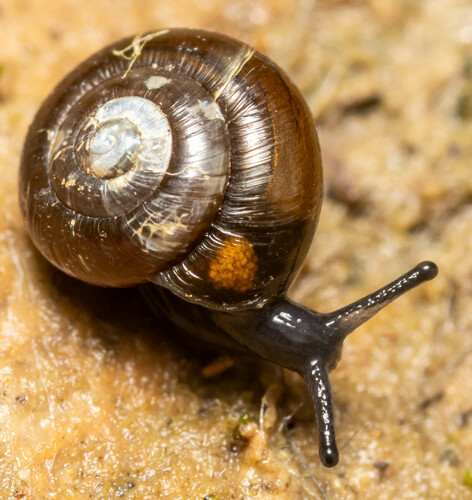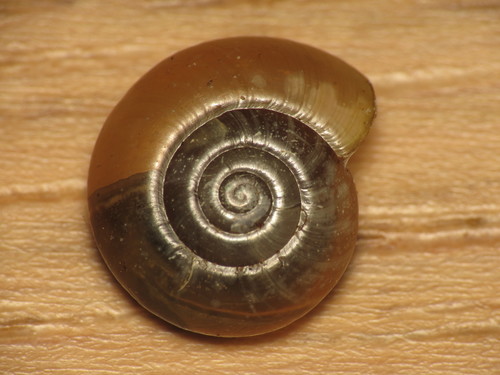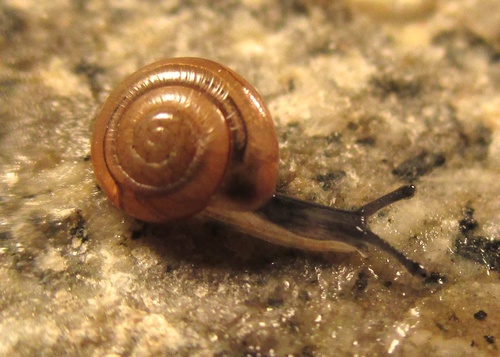
About Zonitoides arboreus (Say, 1817)
Zonitoides arboreus, commonly called the quick gloss snail, is a species of small air-breathing land snail. It is a terrestrial pulmonate gastropod mollusk belonging to the family Gastrodontidae. This species is native to North America. It is widely distributed across all US states except Nevada. It is widespread and common in central British Columbia, particularly in the Peace River-Northern Rockies region. Z. arboreus has been detected in various soil samples collected from Wind Cave National Park, South Dakota, USA. Its non-indigenous distribution covers many regions around the world: it has been introduced to Iceland, Hungary, Switzerland, and the Czech Republic, where it has been non-indigenous in Moravia since 2006; it occurs as a non-indigenous "hothouse alien" in Great Britain and Slovakia; it is also found in Pratas Island (Taiwan), both the North Island and South Island of New Zealand, and the Australian states of New South Wales, Queensland, and Victoria. In most (but not all) of these non-native locations, this species is found as a pest in greenhouses. The quick gloss snail reproduces sexually. Its reproductive system centers on the ovotestis, a lead-shaped gonad that contains both ovarian and testicular tissue, located adjacent to the liver. A narrow hermaphroditic duct connects the ovotestis to the accessory gland, which facilitates sperm transfer. The accessory gland is attached to the albumen gland, an exocrine gland typical of snails, which connects to the oviduct. The oviduct is a larger organ that helps eggs travel from the ovotestis, and it is positioned posteriorly within the vagina. The snail's vas deferens is a cord-like structure attached to the oviduct that leads into the penis sac. Next to the penis sac lies the dart sac, which holds two coronal glands. The vesicula seminalis is a small organ connected to the anterior third of the vagina via a very long duct. The cloaca is a short, thick-walled tube. The dart sac retractor muscle links the dart sac to the duct of the seminal vesicle at the base of the penis. Z. arboreus typically inhabits forest and woodland areas. The nematode Parelaphostrongylus tenuis acts as a parasite of this snail species.