About Zoarces americanus (Bloch & Schneider, 1801)
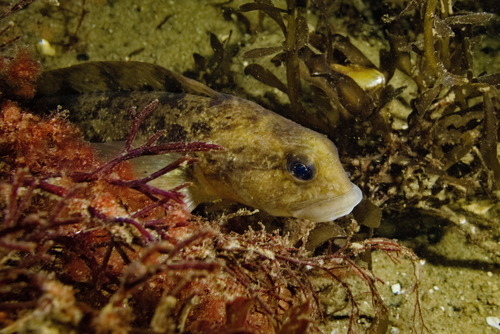
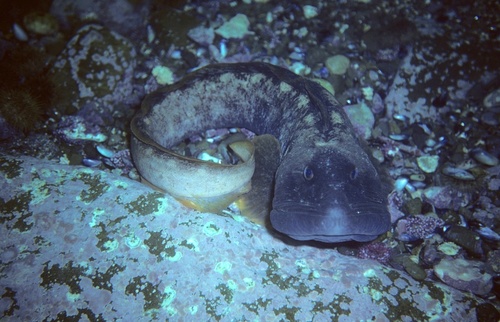
The ocean pout, Zoarces americanus, can be recognized by its long, tapering body and a broad mouth with thick, fleshy lips, where the upper lip extends past the lower lip. Its coloration ranges from yellow to reddish brown and grayish-green, and it has a series of cross-shaped markings running along the length of its eel-like body. A dark brown line runs along each side of the head, from the upper rear edge of the eye to the margin of the operculum. Its long, continuous dorsal fin is not connected to the caudal fin, but the anal fin is. The species has robust, blunt, conical teeth. It is the largest eelpout species, with a maximum recorded total published length of 110 cm (43 in).
This fish is found in the western Atlantic Ocean, ranging from Labrador, Canada, south to Delaware. It is a bottom-dwelling species that most commonly lives on soft sand and mud substrates, though it can also be found in rocky areas. It occurs at depths from 0 to 388 m (0 to 1,273 ft).
Genes from the ocean pout have been successfully inserted into Atlantic salmon for genetic modification. The promoter from the ocean pout's antifreeze protein gene is combined with a growth hormone gene from Chinook salmon. This combination results in higher blood growth hormone concentrations, making the genetically modified salmon grow much faster. These transgenic salmon reach harvest weight in two-thirds of the time required by unmodified salmon. Controversy surrounds this modification, as some people believe escaped transgenic salmon could threaten wild salmon populations. AquaBounty Technologies has responded to these concerns by stating that all transgenic salmon intended for sale will be sterile females. As of late 2017, several tons of this modified salmon had already been sold in Canada, while final approvals and labeling decisions were still pending in the United States. Multiple U.S. restaurant and grocery store chains have announced they will not sell this fish, citing concerns about human consumption safety, even though no scientific evidence supports that the fish poses a risk. In June 2006, the Unilever company announced it would research potential use of genetically modified yeast that produces antifreeze proteins using a gene taken from the ocean pout. The proteins extracted from the yeast would be used to improve the consistency and storage properties of ice cream. Adding these ice-structuring proteins allows manufacturers to make lower-cream, lower-calorie ice cream without the risk of ice crystal formation.