About Zizia aurea (L.) W.D.J.Koch
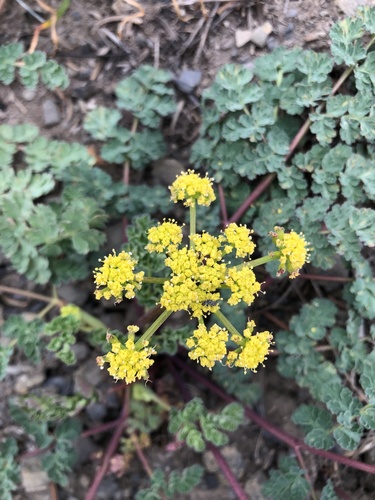
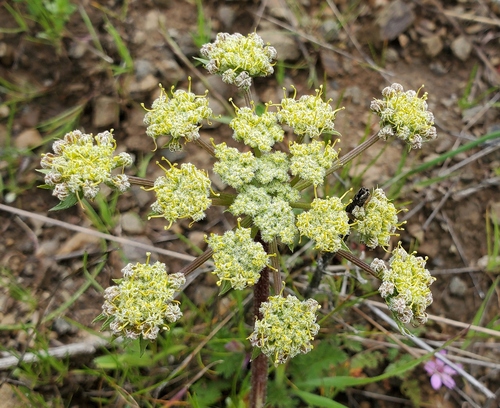
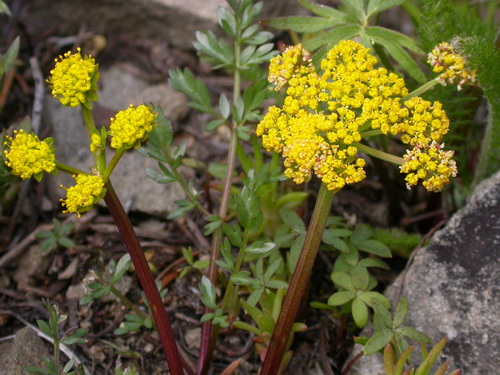
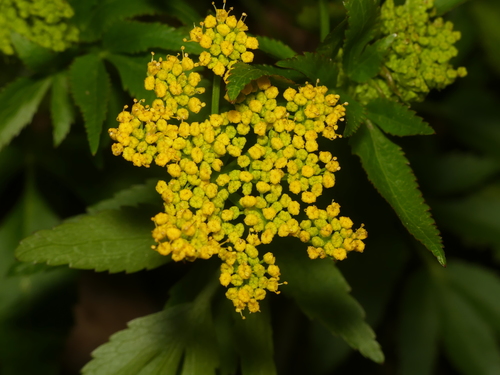
Zizia aurea, commonly known as golden alexander, typically grows 40 to 75 centimetres (16 to 30 inches) tall, and may occasionally reach greater heights. Its leaves are alternately arranged along stems, reaching 8 cm (3+1⁄4 in) long and 5 cm (2 in) wide. Each leaf is compound and odd-pinnate, with leaflets that are usually lanceolate or ovate and have serrated edges. The plant has a root system made up of a dense cluster of coarse fibrous roots. It blooms from May to June, producing small yellow flowers that grow in a flat-topped umbel at the top of the stem. Each flower measures only 3 mm (0.12 in) long, and has five sepals, five petals, and five stamens. Each flower produces a single oblong schizocarp fruit 3 to 4 mm (0.12 to 0.16 in) long that holds two seeds. In autumn, both the leaves and fruit of Zizia aurea turn purple. Golden alexander is native to the United States and Canada, with a range extending from New Brunswick west to Saskatchewan, south to Florida and Texas, and west to Montana. It grows in a wide variety of habitats, including moist black soil prairies, openings in moist to mesic woodlands, savannas, thickets, limestone glades and bluffs, power line clearings in woodland areas, abandoned fields, and wet meadows. While it prefers wet habitats, it can tolerate dry summers, and it is hardy in USDA zones 4–9. Ecologically, Zizia aurea acts as a host plant for caterpillars of the black swallowtail (Papilio polyxenes asterius) and Ozark swallowtail (Papilio joanae) butterflies. Females of the mining bee species Andrena ziziae are oligolectic on Zizia aurea, meaning they feed exclusively on its pollen. Dozens of other insect species including bees, flies, wasps, and butterflies visit the plant’s flowers to feed on its nectar. Native American peoples of the United States and Canada used Zizia aurea for a range of traditional medicinal purposes. A tea prepared from the plant’s leaves and flowers was thought to help treat disorders of the female reproductive system. The root was considered to have hemostatic and hypnotic properties: crushed root was used to treat sharp pains, it was made into poultices to treat inflammations and sores, and an infusion of root as tea was considered to have febrifugal effects. For culinary use, raw Zizia aurea flowers (with tough stems trimmed away) are sometimes added to green salads, and young inflorescences are eaten whole after blanching, prepared in the same way as broccoli.