About Ziphius cavirostris G.Cuvier, 1823
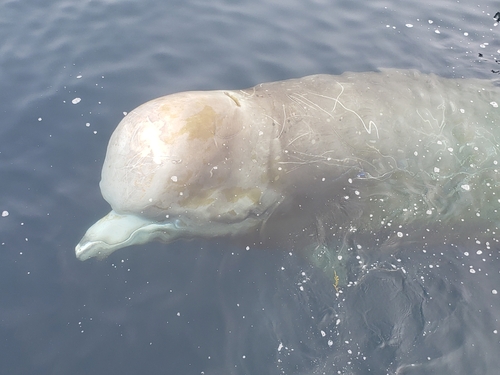
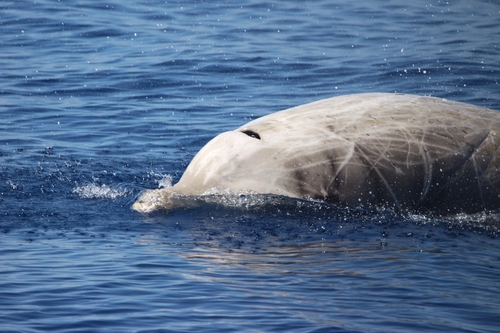
Cuvier's beaked whale (Ziphius cavirostris G.Cuvier, 1823) has a robust, cigar-shaped body similar to other beaked whales, and can be hard to tell apart from many mesoplodont whales when at sea. Males and females are typically similar in size. Adult males are usually dark gray overall, with a distinctly lighter (often even white) head, and this light coloration extends along the posterior of the body. Females range in color from dark gray to reddish-brown; their head lightens to a much smaller degree than males, and the light coloration does not extend along the posterior.
Sex can be determined in Cuvier's beaked whales through genetics, observation of the genital area, the presence or absence of erupted teeth in adults, or the presence of a calf. Pigmentation patterns can also give clues to an individual's sex. Adult males have a contrasting uniform white cape that usually extends to the area around the dorsal fin, and individual adult males range in overall color from dark to almost white. However, more than a third of adult females have "sharp" pigmentation patterns that match those of adult males, so pigmentation pattern alone cannot be used to tell males and females with this pattern apart. Most adult females have a "soft" set of pigmentation features, characterized by a brownish color and a shorter contrasting white cape, but similar patterns have been observed in subadult individuals of both sexes, meaning a "soft" pigmentation pattern alone is not enough to confirm an individual is female.
At birth, Cuvier's beaked whales weigh approximately 250–300 kg (550–660 lb) and measure 2–3 m (6 ft 7 in – 9 ft 10 in) in length. Calves are black or dark blue with a white belly. Females reach sexual maturity at an average length of 5.8–6.7 m (19–22 ft), while males reach maturity at 5.8–7.0 m (19–23 ft), and mature individuals weigh around 2 to 3.5 tons.
Cuvier's beaked whale is an odontocete, or toothed whale. Only adult males have erupted teeth; they also develop two tusks in the left and right corners of their lower jaw. It has been hypothesized these tusks are used for dueling between males (though this behavior has never been observed), and they may also be used to fend off threats such as orcas. Adult individuals have numerous scars along their sides, which can be used to identify individuals. Researchers think the scars come from fights with other males, attacks by predators, battles with squid, or interactions with cookiecutter sharks, which can scrape or punch holes directly in the whales' sides. Scarring is more frequent in males than females, and scar frequency tends to increase with age. This species can live up to 62 years.
Cuvier's beaked whale has a short, blunt head, with a gradually sloping forehead, a small, poorly defined beak, and a slight melon. While this general appearance is shared by all beaked whales, Cuvier's beaked whale has a shorter, blunter beak that sets it apart from other members of the family Ziphiidae. In profile, its small, softly defined rostrum gives it the alternative common name of goose-beaked whale.
Cuvier's beaked whale has a cosmopolitan distribution, found in deep offshore waters from the tropics to cool temperate seas. In the North Pacific, it ranges as far north as the Aleutian Islands; in the North Atlantic it ranges as far north as Atlantic Canada in the west, and to Shetland in the east. In the Southern Hemisphere, it occurs as far south as Tierra del Fuego, South Africa, southern Australia, New Zealand, and the Chatham Islands. It also inhabits inland water bodies including the Gulf of Mexico, the Caribbean Sea, and the Mediterranean Sea. The Mediterranean population may be genetically distinct from North Atlantic populations.
Cuvier's beaked whale is likely one of the most common and abundant beaked whale species, with a total worldwide population likely well over 100,000. An estimated 80,000 individuals live in the eastern tropical Pacific, nearly 1,900 live off the west coast of the United States (excluding Alaska), and more than 15,000 live off Hawaii. The Gulf of Mexico population is extremely small, and requests have been made to list this group as a protected species. As of 2019, this request was rejected because there was insufficient scientific evidence to classify it as a distinct population segment (DPS) under the Endangered Species Act (ESA).
Relatively little is known about the diving and feeding behavior of Cuvier's beaked whale. Evidence suggests that this species carries out highly coordinated foraging dives in small social groups. This behavior may reduce predation risk, and does not appear to impact the whales' foraging success. Cuvier's beaked whale prefers to dive deep and uses suction to capture prey including squid and deep-sea fish. When diving deep for prey, the whale opens its jaw, expands its throat, and moves its tongue to create a pressure change that sucks prey directly into its mouth. This species has throat pleats similar to those of rorquals that allow the throat to expand, which likely helps generate a stronger suction force. Due to its jaw structure, the species has a fixed expression that looks like a permanent smile, similar to dolphins.
The melon, the bump on top of the whale's head, holds its echolocation organ. This allows the whale to use sound waves to locate potential food sources, which is useful in the deep sea where no sunlight reaches. Deep diving paired with echolocation appears to help Cuvier's beaked whales avoid competition for their prey.
Scientists have studied the species' feeding habits by examining stomach contents from beached specimens. Analysis of Pacific Ocean individuals found that cephalopods made up 98.0% (by number) and 87.7% (by mass) of Cuvier's beaked whale diet, including at least 37 different varieties of squid of varying sizes from both the mesopelagic and bathypelagic zones. Prey includes squid from the families Cranchiidae, Onychoteuthidae, Brachioteuthidae, Enoploteuthidae, Octopoteuthidae, and Histioteuthidae, alongside deep-sea fish.
Comparisons of stomach contents from Pacific whales and Mediterranean whales found that Mediterranean whales primarily feed on squid found at depths of 1,000 to 2,000 feet. Pacific individuals from Monterey, California (2015), Taiwan (1995), Alaska, and Baja California have access to much deeper water; in addition to catching prey in the benthopelagic zone, they consume a mix of crustaceans and cephalopods deeper in the bathypelagic zone. Deep-sea molluscs and octopus only found in these deep regions are also sometimes eaten in the bathypelagic zone. One whale retrieved from Monterey in 2015 was found to have eaten 200 squids, five fish, and one very deep-sea shrimp. The shrimp and most of the squid were from the bathypelagic zone, and the fish were giant grenadiers from benthopelagic ocean floors.