About Zinnia grandiflora Nutt.
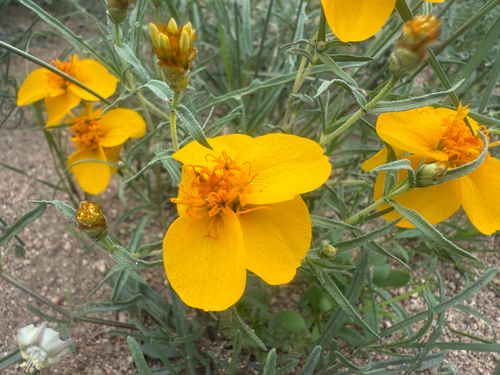
Zinnia grandiflora Nutt. is a small flat-topped or rounded subshrub that reaches up to 22.5 centimetres (9 in) tall, with many short, woody stems. Its leaves are arranged oppositely, grow up to 2.5 cm (1 in) long, and are linear in shape. The above-ground plant parts are covered in short, rough hairs. Flower heads measure 2.5–4 cm (1–1+1⁄2 in) wide, bearing 3 to 6 roundish yellow-orange ray florets. A cluster of reddish or greenish disc florets sits at the center of the head. Blooming is reported to occur from June to October, and also from around April through November. The species is native to the southwestern and south-central United States, specifically Kansas, Oklahoma, Texas, Colorado, New Mexico, and Arizona, as well as northern Mexico, specifically Chihuahua, Coahuila, Sonora, Tamaulipas, Nuevo León, and Zacatecas. It grows on plains, foothills, and other dry habitats, and grows best in full sun with drier soil. It is drought tolerant and cannot survive in wet conditions. Because of its rhizomes (horizontal stems that grow along the ground that make the plant very sturdy), Zinnia grandiflora works very well to control erosion. It is also beneficial to pollinators: it has no significant insect problems, and attracts garden-friendly insects such as butterflies. Zinnia grandiflora has a range of uses including medicinal purposes, dyes, and paint, and it is non-toxic to pets. Several Native American groups, including the Zuni and Navajo, use the plant for medicinal and ceremonial purposes. Among the Zuni people, a poultice made from the plant is applied to bruises, a cold infusion of the blossoms is used as an eyewash, and smoke from powdered plant is inhaled in a sweatbath to treat fever. The Acoma and Laguna Indians drank an infusion of Z. grandiflora to heal kidney illnesses. The plant was also used to dye buckskins yellow, and adding the flower to water or white clay allows it to be used to color wool.