About Zingiber officinale Roscoe
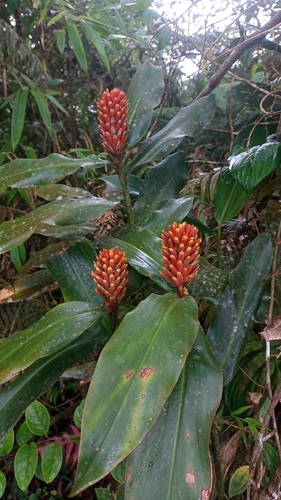
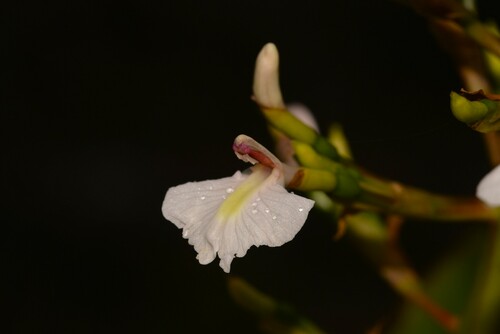
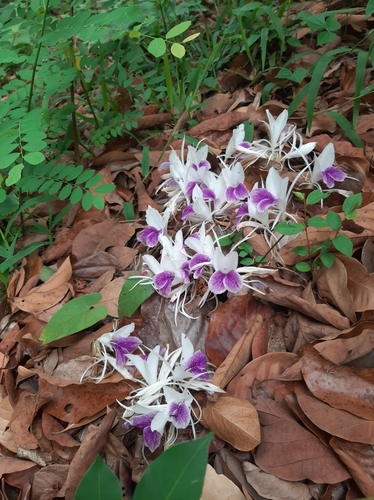
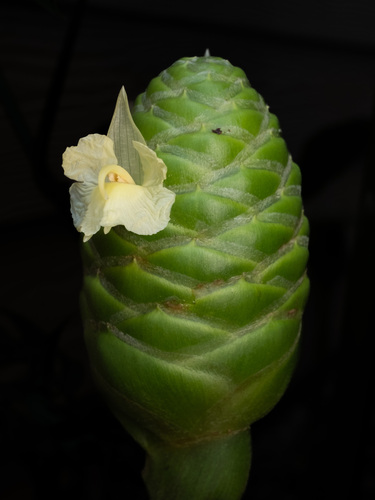
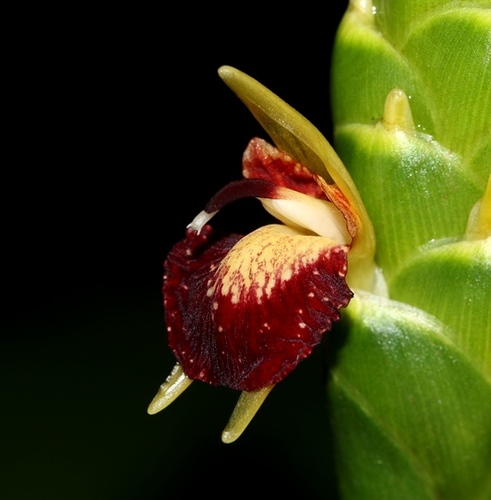
Zingiber officinale Roscoe, commonly known as ginger, is a flowering plant whose rhizome (called ginger root or simply ginger) is widely used as a spice and in folk medicine. It is an herbaceous perennial that grows annual pseudostems—false stems formed from rolled leaf bases—that reach around one meter tall, and bear narrow leaf blades. Its inflorescences, which produce flowers with pale yellow petals and purple edges, grow directly from the rhizome on separate shoots. Ginger belongs to the family Zingiberaceae, which also includes turmeric (Curcuma longa), cardamom (Elettaria cardamomum), and galangal. Distantly related dicots in the genus Asarum are commonly called wild ginger due to their similar taste. Ginger originated in Maritime Southeast Asia, and it is a true cultigen that does not exist in a wild state. It was most likely first domesticated by Austronesian peoples, who carried it across the Indo-Pacific during the Austronesian expansion starting around 5,000 BP, reaching as far as Hawaii. Ginger was one of the first spices exported from Asia, arriving in Europe via the spice trade, and was used by ancient Greeks and Romans. Austronesian peoples cultivated multiple ginger species besides common ginger, including turmeric (Curcuma longa), white turmeric (Curcuma zedoaria), and bitter ginger (Zingiber zerumbet). For Austronesians, ginger rhizomes and leaves were used to flavor food or eaten directly; leaves were also used to weave mats. Beyond these practical uses, ginger held religious significance for Austronesians, used in healing rituals, rituals to request protection from spirits, and the blessing of Austronesian ships. Austronesian voyagers introduced ginger to Pacific Islands in prehistory, long before contact with other civilizations; traces of the Proto-Malayo-Polynesian word *laqia for ginger appear in Austronesian languages as far as Hawaii. It is thought that Austronesian sailors also introduced ginger to India around 3,500 BP, alongside other Southeast Asian food plants and sailing technologies, during early contact with Dravidian-speaking peoples of Sri Lanka and South India. In the 1st millennium CE, Austronesian voyagers also brought ginger to Madagascar and the Comoros. From India, traders carried ginger to the Middle East and Mediterranean by around the 1st century CE. During the spice trade, ginger was primarily grown in southern India and the Greater Sunda Islands, alongside peppers, cloves, and many other spices. Ginger has been used in traditional medicine in China, India, and Japan for centuries, and is used as a modern dietary supplement. Research suggests ginger may provide greater benefit than placebo for nausea and vomiting during pregnancy, but there is no good evidence it helps with nausea caused by chemotherapy. It remains uncertain whether ginger is effective for treating any disease. In 2023, total world ginger production was 4.9 million tonnes, with India producing 45% of the global total, leading all producing countries. When consumed in reasonable quantities, ginger causes few negative side effects, but large amounts may lead to adverse events including gastrointestinal discomfort and unwanted interactions with prescription drugs. The U.S. Food and Drug Administration lists ginger as "generally recognized as safe", though it does interact with some medications, including the anticoagulant warfarin and the cardiovascular drug nifedipine. Even though it is generally recognized as safe, ginger can cause heartburn and other side effects, particularly when consumed in powdered form. It may have negative effects on people with gallstones, and can interfere with the effects of anticoagulants such as warfarin or aspirin, as well as other prescription drugs.