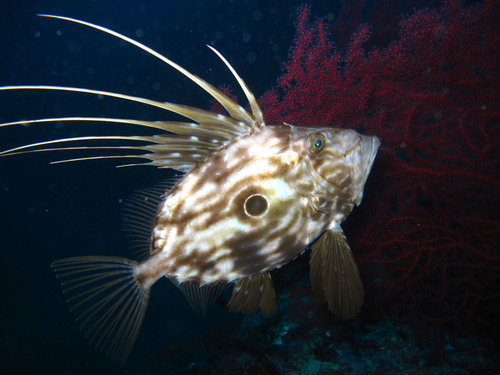
About Zeus faber Linnaeus, 1758
Zeus faber Linnaeus, 1758, commonly known as John Dory, has the following morphological characteristics. The species reaches a maximum length of 65 cm (26 in) and a maximum weight of 5 kg (11 lb). It has 10 long spines on its dorsal fin and 4 spines on its anal fin. Microscopic, sharp scales cover its entire body. Its body is olive green with a silver white belly, and it has a distinct dark spot on its side. Its eyes sit close to the top of its head, and it has a flat, round body shape. John Dory is a poor swimmer. John Dory are benthopelagic coastal fish, found along the coasts of Africa, Southeast Asia, New Zealand, Australia, Japan, and Europe. They live close to the seabed at depths ranging from 5 to 360 metres (20 to 1,180 ft). They are normally solitary, and are more common in the waters around New Zealand’s North Island than in the colder waters surrounding the South Island. John Dory reach reproductive maturity when they are three or four years old. Spawning occurs around the end of winter. They are substrate scatterers, meaning they release sperm and eggs into open water for external fertilization. The typical wild lifespan of this species is around 12 years. As a food fish, John Dory is noted in cookery writing. In her 1845 work Modern Cookery for Private Families, cookery writer Eliza Acton observed that though John Dory has an uninviting appearance, some people consider it the most delicious fish served at table. Acton recommends baking the fish very gently to prevent it from drying out in the oven. Today, John Dory is popular among professional chefs for its culinary versatility, but it is not widely accessible to home cooks. As a bycatch species, it is not typically sold in supermarkets.

