About Zerynthia rumina (Linnaeus, 1758)
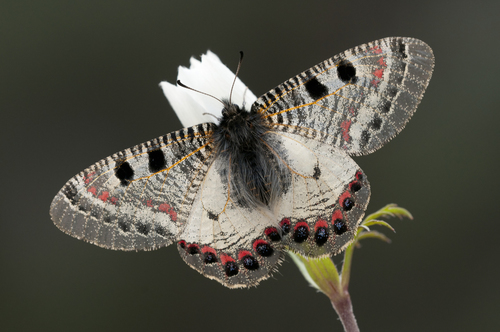
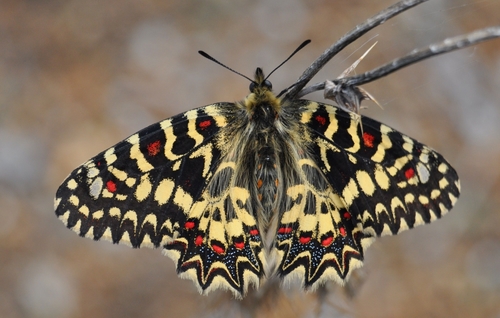
Zerynthia rumina (Linnaeus, 1758) is an extremely striking butterfly species. In southeast France, it may be confused with the southern festoon Zerynthia polyxena. The two can be distinguished by blue coloration on the hindwing of Z. polyxena, and Z. rumina also has extensive red on its forewings. According to Seitz's description, T. rumina L. (10a) is immediately distinguished from polyxena by the entirely different underside of its hindwing, which bears whitish yellow spots at the base. Nearly all costal spots on the forewing are marked with red. The 3 or 4 parallel black cell bars present in polyxena are enlarged in rumina, separated by thin yellow bands. This species occurs in Spain, Portugal, Morocco, and Algiers; in Morocco and Algiers, it is only found in coastal districts in a slightly different form (10a).
Aberration canteneri Stgr. (10a) occurs singly alongside typical rumina in southern Spain and Morocco. In this form, the ground color is dark yellow, almost orange, making the transparent apical spot very prominent and bright silvery. Aberration honnorati Boisd. (10a) is a form where red coloration is greatly extended, with hindwing spots merging to form an often broad purple band. This form occurs in southern France, especially near Digne, but is very rare. The common form of southern France is medesicaste Ill. (10a), where the black spots of the forewing are mostly centered with red, while the red spots of the hindwing remain separate. Melanotic (dark/black) aberrations of these forms have been recorded: the black aberrations of Spanish rumina is named tristis Oberth., while the black form of French medesicaste is hartmanni Stdfss.
In aberration paucipunctata Neub., all red spots on the forewing are reduced. In aberration alicea Neub., the third (reduced) black costal spot has no red center. Transitions between typical rumina and medesicaste are called aberration castiliana, named after Castilia. The larva is yellow, red, or blackish, with short pale stripes and yellowish red tubercles that bear black hairs. It develops in early summer, feeding on Aristolochia. The pupa is grey-brown, variegated with black. Adult butterflies are on the wing in spring; they emerge as early as February in southern regions, and as late as March in northern Spain. They inhabit sunny slopes and vineyards, and often settle on Asphodelus. The overall distribution of Zerynthia rumina includes North Africa, the Iberian Peninsula, and southern France.