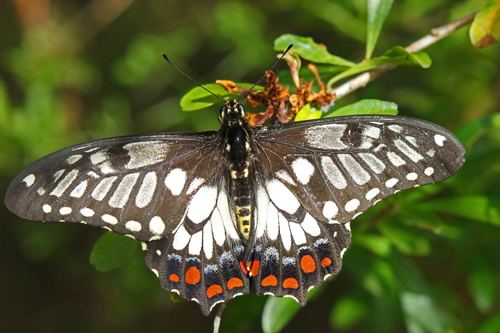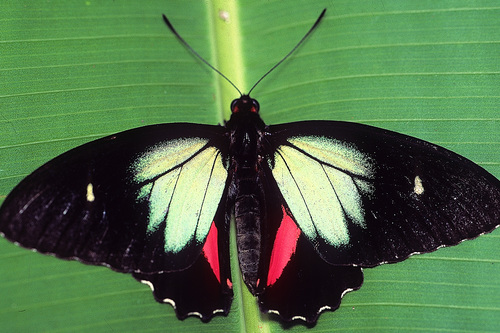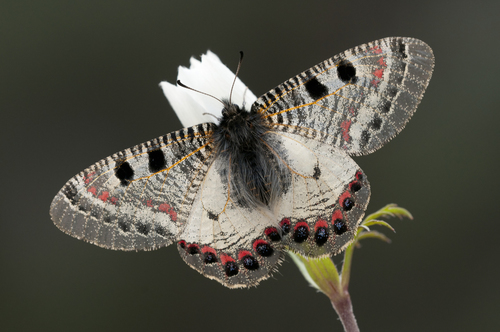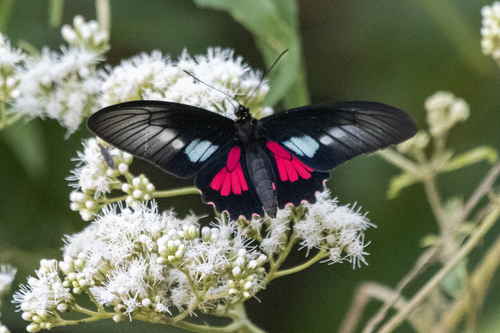
About Zerynthia polyxena (Denis & Schiffermüller), 1775
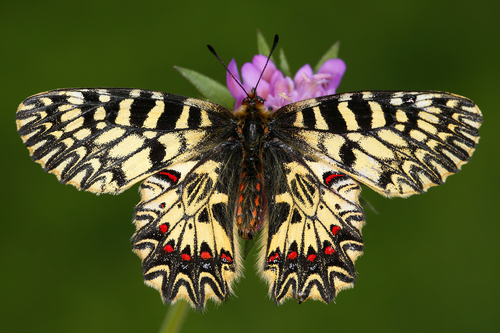
Zerynthia polyxena, commonly called the southern festoon, can reach a wingspan of 46–52 mm. Females have slightly longer wings, and are usually lighter in color than males. The base wing color is yellow, marked with a complex pattern of multiple black bands and spots. Along the edges of the hindwings runs a sinuous black line, paired with a series of blue and red warning spots that use aposematism to deter potential predators. The body is dark brown, with red patches on the sides of the abdomen. This species closely resembles the Spanish festoon (Z. rumina), and can only be confused with that species. It can be distinguished from Z. rumina by the presence of blue on its hindwings, and by having relatively less red on its forewings. The ranges of these two species only overlap in southeast France. Fully grown Z. polyxena caterpillars reach up to 35 millimeters long. They are black when young, and become yellowish later in development, with six rows of fleshy orange and black spikes covering the entire body. Seitz's description lists T. polyxena Schiff. & Den. (= hypermnestra Scop., hypsipyle Fabr.), which is light yellow with spots and dentate lines, and bears red submarginal spots on the hindwing. Its distribution ranges from Southern France to the Black Sea in South Europe, and extends into Asia Minor. The aberration ab. rumina Esp. has red centers on the black costal spots of the forewing even on the upperside; typically, such red dots only appear on some areas of the underside. This form is not uncommon in some localities, including the West of the Balkan Peninsula. Aberration ab. cassandra Hb. (= demnosia Frr., creusa Meig.) (9f) refers to specimens where the black coloration is extended; however, the proportional amount of black varies greatly between individuals. These melanotic specimens occur as single rare aberrations across most of the range, but are the only form found in some localities such as Dalmatia. Aberration ab. ochracea Stgr. (= polymnia Mill.) (9f) describes individuals where the typical light yellow base color is replaced by a rich dark yellow. This form also occurs mixed with the standard form across the range, but is especially abundant in certain locations. Aberration ab. meta Meig. (= flavomaculata Schilde, rufescens Oberth., rumina, alba Esp) (9f) is a rare aberration found across the entire range, in which the red color of the spots is replaced by dark yellow. In aberration ab. bella Neub., the third costal spot is reduced. The full-grown larva is reddish yellow to black-brown, with pointed setiferous tubercles. It develops in May and June on Aristolochia, especially in moist, warm localities. Claims that larvae also feed on Quercus ilex are almost certainly due to an error of identification. The pupa is very slender, yellowish grey, and marked with brown. Z. polyxena is widespread across central and southern Europe, including southeastern France, Italy, Slovakia, Greece, and the entire Balkan region, and reaches as far east as southern Kazakhstan and the Urals. Despite its wide overall range, it only occurs in local, scattered populations. This local rare butterfly inhabits warm, sunny open places, including grassy herb-rich meadows, vineyards, river banks, wetlands, cultivated areas, brushy areas, wasteland, rocky cliffs and karst terrains. It occurs at elevations from 0 to 1,700 metres above sea level, but is most commonly found below 900 metres.