About Zerynthia cerisy (Godart, 1824)
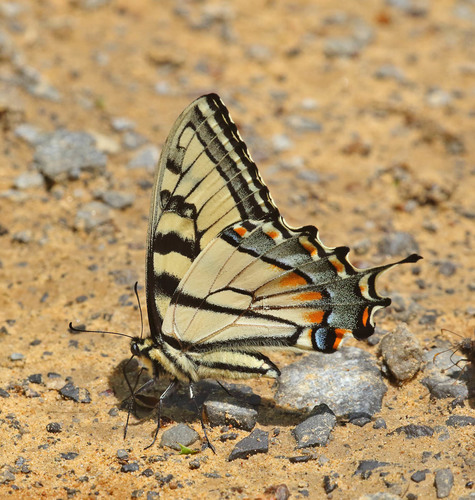
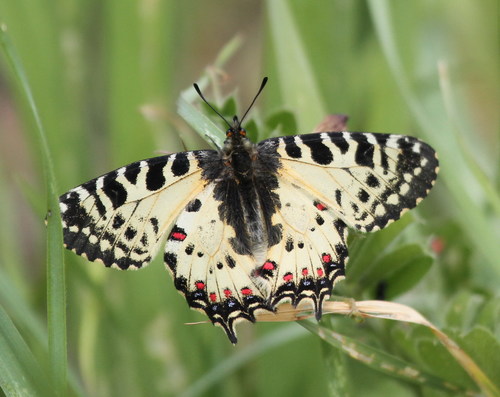
Scientific name: Zerynthia cerisy (Godart, 1824), described in Seitz as T. cerisyi God. (9d). This species closely resembles the male of Sericinus in color and pattern: it has black spots on a pale yellow base, with faint red markings on the hindwing near the middle of the costal margin and at the anal angle. The hindwing has only one strongly prominent tooth. Zerynthia cerisy is found in the Balkan States, Greece, and Asia Minor. It is less common than Zerynthia polyxena, and is on the wing from April through early June, emerging even earlier in southern districts. Females of Zerynthia cerisy vary greatly. Dealers sell specimens with very heavy black spotting as the aberration obscurior (9d). In aberration albidior (9e), the ground color is white; in ochracea (9e) it is bright yellow; in pallidior (9d) it is fallow. In aberration flavomaculata Verity, the carmine dots are replaced by honey-colored dots. All of these aberrations occur alongside typical Zerynthia cerisy. The taxon caucasica Led. is now recognized as the separate species Allancastria caucasica (9e). Both sexes of this species have very large, broad black costal spots on the forewing; the hindwing is slightly and almost evenly scalloped, with the central tooth barely projecting. It is found in Armenia. The taxon deyrollei Oberth. is now the separate species Allancastria deyrollei (9d). This species has the three teeth located before the anal angle of the hindwing extended into short tails. It occurs in the coastal districts of the Black Sea, across the whole of Asia Minor, and extends southward to Syria. It is extremely common, and can be found in enormous numbers in some locations. The taxon cretica Reb. (9e) is now the separate species Allancastria cretica. It occurs on Crete and some Greek islands. It is a lightly marked form, where the three hindwing teeth mentioned earlier are only marked by black curved lines, and the wing edge is not distinctly excised. It is less common than the preceding taxon (Allancastria deyrollei). The larva of Zerynthia cerisy is yellow, brown, or reddish, with red tubercles. It develops from May through July, feeding on Aristolochia. The pupa is dust-colored or yellowish grey, patterned with thin black dashes, most prominently on the head. The adult butterflies fly on the first warm days of the year, in rocky areas and along wood edges.