About Zerene eurydice (Boisduval, 1855)
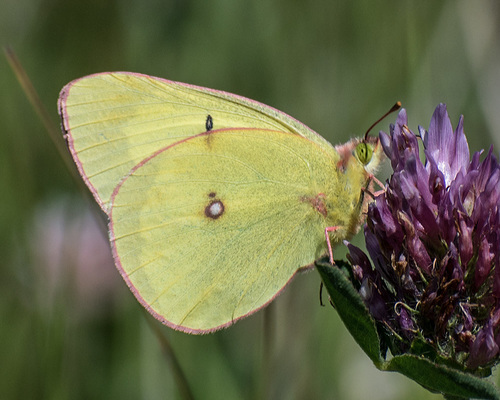
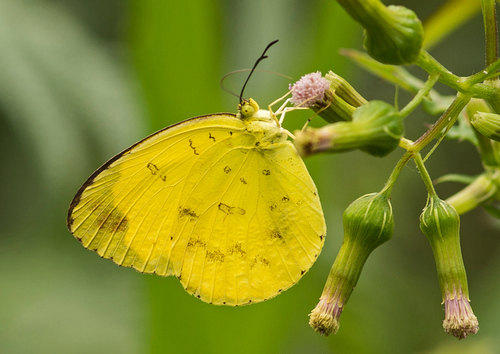
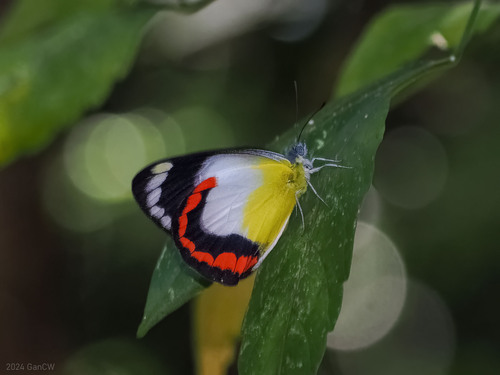
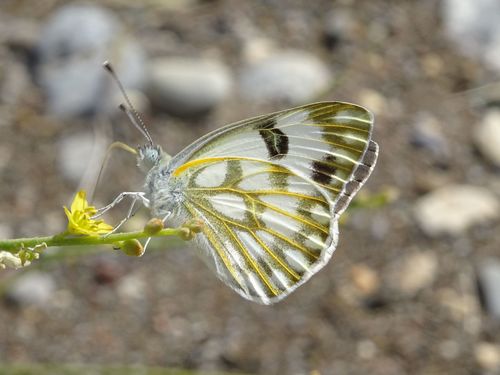
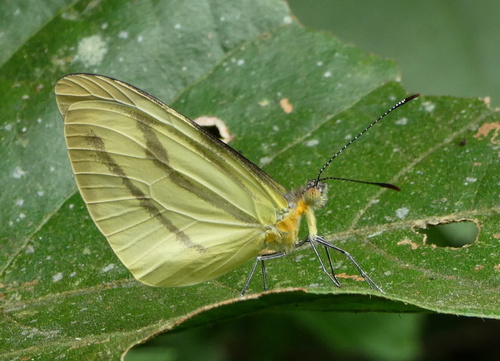
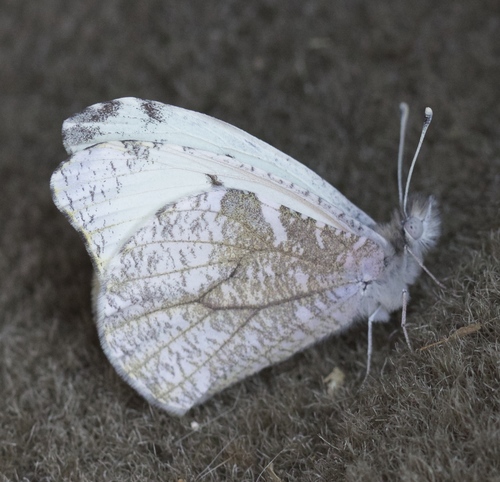
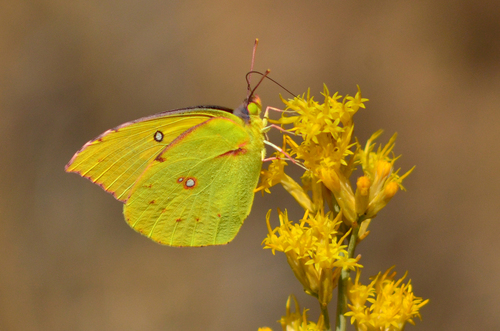
This species has the scientific name Zerene eurydice (Boisduval, 1855), commonly called the California dogface butterfly. It gets its common name from the wing coloration, which is most distinct in males. Only Zerene eurydice has UV patterns on its dorsal forewings. Females mostly have yellow wings, with two black dots or dashes on each forewing. Males have black coloring on the outer edges of their forewings, which usually encloses a yellow-orange area and two black dots. Male Z. eurydice have an iridescent pigment in their dorsal forewings created by light-reflecting chitin structures, and this trait is linked to higher mating success. The average wingspan of Zerene eurydice ranges from 5.1 to 6.3 cm. The butterfly's wings are covered in scales that help with flight aerodynamics and heat insulation, while its overall body has setae hairs that sense vibration and touch. The distribution of Z. eurydice is limited entirely to California, and it is most commonly found in the San Bernardino Mountains and Santa Ana Mountains of Southern California. Its habitat includes foothills, chaparral, and oak or coniferous woodlands, which are temperate and terrestrial in this region. Larvae of Z. eurydice feed exclusively on Amorpha californica and Amorpha fruticosa, both members of the plant family Fabaceae. These host plants grow near poison oak, willow, and streambanks. During the larval and pupal stages, Zerene eurydice are greenish yellow, matching the coloration of their Fabaceae host plants, and depend on Amorpha californica and Amorpha fruticosa to camouflage themselves from predators. These butterflies fly very quickly and are hard to approach unless they are nectaring at flowers. This makes it difficult to photograph them with their wings open. Their fast flight helps them escape from predators including ants, spiders, wasps, parasitic wasps, parasitic flies, birds, rats, toads, lizards, praying mantis, and snakes. Adult butterflies are attracted to areas with moist soil and feed on the nectar of multiple flower species; they are especially known to prefer blue gilia, sunflowers, and thistle blooms. The breeding season for Zerene eurydice runs from early spring to late summer, and females lay an average of one hundred eggs per breeding season. Z. eurydice typically begin flying around 7 a.m. and continue flying until the afternoon. Flight is not continuous, and the butterflies will often roost in bushes. Females usually start flying one to two hours later than males.