About Zephyranthes rosea Lindl.
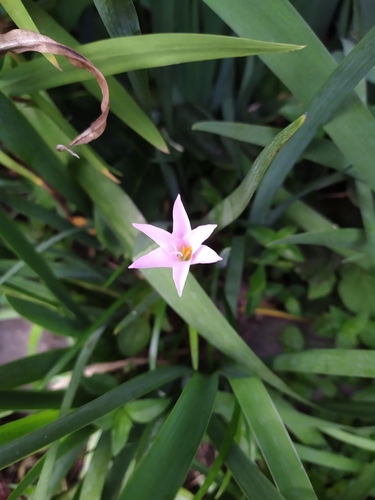
Zephyranthes rosea Lindl. are perennial herbaceous monocots. They are small plants, reaching only 15 to 20 cm (5.9 to 7.9 in) in height. They grow from spherical tunicate bulbs that are around 1.5 to 2.5 centimetres (0.59 to 0.98 in) in diameter, and produce five to six narrow, flattened, dark green linear leaves, each about 3 to 4 mm (0.12 to 0.16 in) wide. Single funnel-shaped flowers grow erect or slightly inclined on scapes around 10 to 15 cm (3.9 to 5.9 in) long. The flower spathes measure around 2 to 2.8 cm (0.79 to 1.10 in) long and are only slightly divided at the tip. These fragrant six-petaled flowers are around 2.5 cm (0.98 in) in diameter and 3 to 3.5 cm (1.2 to 1.4 in) in length. The perianth is bright pink with a short green central perianth tube that is less than 5 mm (0.20 in) long. The six stamens are of different lengths: one is 11 mm (0.43 in), one is 16 mm (0.63 in), and four measure between 12 and 13 mm (0.47 and 0.51 in). All stamens are shorter than the style and are inserted at the mouth of the perianth; the anthers on the stamens are 3 to 6 mm (0.12 to 0.24 in) long. After flowering, plants develop seed capsules that are deeply divided into three lobes, holding shiny black flattened seeds. Zephyranthes rosea is native to Peru and Colombia. It is widely planted in warmer regions around the world, and is reportedly naturalized in Florida, India, the West Indies, and many islands of the Pacific and Indian Oceans. This species is common in recently disturbed land and grassy areas such as lawns and meadows that receive periodic rainfall. Like other members of the genera Zephyranthes and Habranthus, the bulbs of Z. rosea contain various toxic alkaloids, including lycorine and haemanthamine. Consumption of the bulbs can cause vomiting, convulsions, and death in humans, livestock, and poultry. Zephyranthes rosea is usually propagated by dividing clumps of bulbs, but can also be grown from seeds. It is widely cultivated as an ornamental plant. It is relatively low-maintenance, and becomes dormant during extended periods of drought, though it is less tolerant of colder temperatures than other species in the genus Zephyranthes. In India, it is also used in folk medicine alongside Zephyranthes flava.