About Zenaida macroura (Linnaeus, 1758)
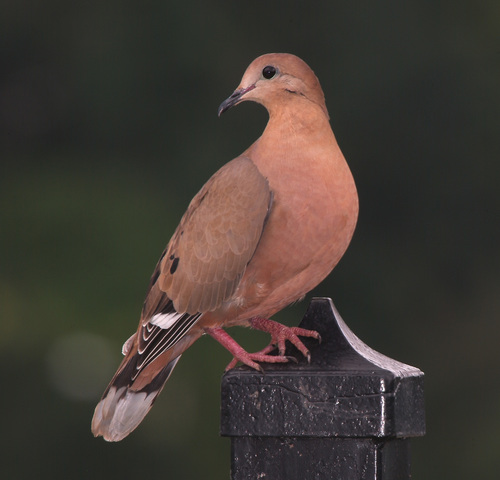
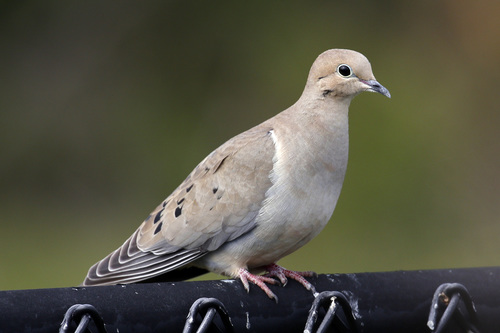
The mourning dove (Zenaida macroura) is a medium-sized, slender dove, with an approximate length of 31 cm (12 in). Its weight ranges from 112 to 170 g (4.0–6.0 oz), and most individuals average close to 128 g (4.5 oz). The mourning dove has a wingspan of 37–45 cm. Its wings are broad and elliptical, and it has a rounded head. Its tail is long and tapered; the species epithet "macroura" comes from the Greek words for "large" and "tail". Mourning doves have perching feet, with three toes pointing forward and one reversed. The legs are short and reddish colored. The beak is short and dark, typically a brown-black hue. The species' plumage is generally light gray-brown on the upperparts, and lighter with a pinkish tint on the underparts. The wings have black spotting, and the outer tail feathers are white, which contrasts with the black inner tail feathers. Below the eye, there is a distinctive crescent-shaped patch of dark feathers. The eyes are dark, with light blue skin surrounding them. Adult males have bright purple-pink patches on the sides of the neck, with light pink coloring extending to the breast. Adult males also have a distinctly bluish-grey crown, which females do not have. Females are similar in overall appearance, but have more brown coloring across their bodies and are slightly smaller than males. Iridescent feather patches on the neck above the shoulders are nearly absent in females, but can be quite vivid on males. Juvenile birds have a scaly feather appearance and are generally darker. Feather colors in mourning doves were long thought to be relatively static, changing only by small amounts over periods of months. However, a 2011 study argued that since feathers have neither nerves nor blood vessels, any observed color changes must be caused by external stimuli. Researchers analyzed how the iridescent feathers of mourning doves responded to stimulus changes involving adding and evaporating water. They discovered that iridescent feather color changed hue, became more chromatic, and increased overall reflectance by almost 50%. Transmission electron microscopy and thin-film models showed that this color is produced by thin-film interference from a single layer of keratin around the edge of feather barbules, under which sits a layer of air and melanosomes. When environmental conditions changed, the most striking morphological difference was a twisting of colored barbules that exposed more of their surface area for reflection, which explains the observed increase in brightness. Overall, the researchers concluded that some plumage colors may be more changeable than previously thought possible. All five recognized subspecies of the mourning dove look very similar and are not easily distinguishable. The nominate subspecies has shorter wings, and is darker and more buff-colored than the average mourning dove. Z. m. carolinensis has longer wings and toes, a shorter beak, and is darker in color. The western subspecies has longer wings, a longer beak, shorter toes, and is more muted and lighter in color. The Panama mourning dove has shorter wings and legs, a longer beak, and is grayer in color. The Clarion Island subspecies has larger feet, a larger beak, and is darker brown in color. The mourning dove has a large range covering nearly 11,000,000 km2 (4,200,000 sq mi). The species is resident year-round throughout the Greater Antilles, most of Mexico, the Continental United States, southern Canada, and the Atlantic archipelago of Bermuda. These birds appear only in summer in much of the Canadian prairie, and only in winter in southern Central America. The mourning dove occurs as a vagrant in northern Canada, Alaska, and South America. It has been recorded as an accidental visitor at least nine times in the Western Palearctic, with five records from the British Isles, two from Sweden, one from the Azores, and one from Iceland. In 1963, the mourning dove was introduced to Hawaii, and a small population was present in North Kona by 1998. The mourning dove was also recorded on Socorro Island, off the western coast of Mexico, in 1988, sixteen years after the Socorro dove was extirpated from the island. The mourning dove occupies a wide variety of open and semi-open habitats, including urban areas, farms, prairie, grassland, and lightly wooded areas. It avoids swamps and thick forest. Mourning doves sunbathe or rain bathe by lying on the ground or a flat tree limb, leaning over, stretching one wing, and holding this posture for up to twenty minutes. These birds can also water bathe in shallow pools or birdbaths, and dustbathing is also common. Outside of the breeding season, mourning doves roost communally in dense deciduous trees or conifers. During sleep, the head rests between the shoulders, close to the body; it is not tucked under the shoulder feathers as it is in many other dove species. During winter in Canada, evening flights to roosting sites and morning flights out of roosts are delayed on colder days.