About Zenaida auriculata (Des Murs, 1847)
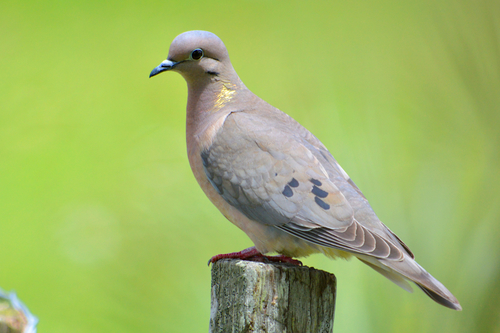
The eared dove, Zenaida auriculata, measures 24 cm (9.4 in) in length and typically weighs around 112 g (4.0 oz), with a long, wedge-shaped tail. Adult males have primarily olive-brown plumage on their upperparts, marked with black spots on the wings. Their head has a grey crown, a black line running behind the eye, and blue-black coloring on the lower ear coverts; these distinct black markings give the species both its English common name and scientific specific name. Adult males have vinous underparts, a tail tipped with cinnamon, a black bill, and dark red legs. Females are duller in coloration than males, while immature birds are very dull greyish-brown with pale barring. The species’ call is a deep, soft oo-ah-oo. Eared doves are common to abundant in savannas and other open areas, including cultivated land. They readily adapt to human habitation: they have been observed on wires and telephone posts near towns in Trinidad and Venezuela, in almost all public spaces of large urban areas such as Bogotá, Colombia, and feeding near beach resorts in Tobago. Eared doves feed mainly on seeds and grain gathered from the ground, and can be agricultural pests. When agricultural crops are in season, plants including wheat, rice, sorghum, maize, and soybeans may make up the entirety of their diet. The common savannah grass Echinochloa colona and Croton jacobinensis are also important seed food sources for this species. Their diet may be supplemented with small animal foods, including caterpillars, insect pupae, aphids, and snails. When not feeding, this is a gregarious bird that forms flocks, especially during migration or at communal roosts. Its flight is high, fast, and direct, with regular wingbeats and an occasional sharp flick of the wings, a characteristic shared by most pigeons. It performs a breeding display consisting of a steep climb followed by a semicircular glide back to its original perch. The bird builds a small stick nest several meters above ground in a tree, and lays two white eggs. The eggs hatch after 12 to 14 days of incubation, and young birds fledge 9 days after hatching. Across most of the species’ range, there is no fixed breeding season; when sufficient food and habitat are available, eared doves breed almost continuously.