About Zegris eupheme (Esper, 1804)
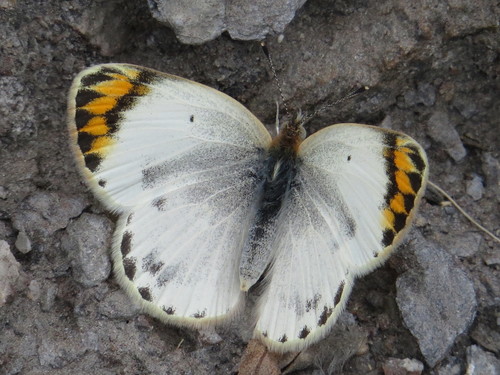
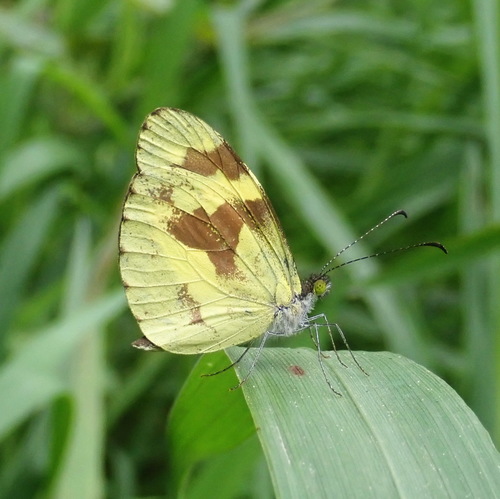
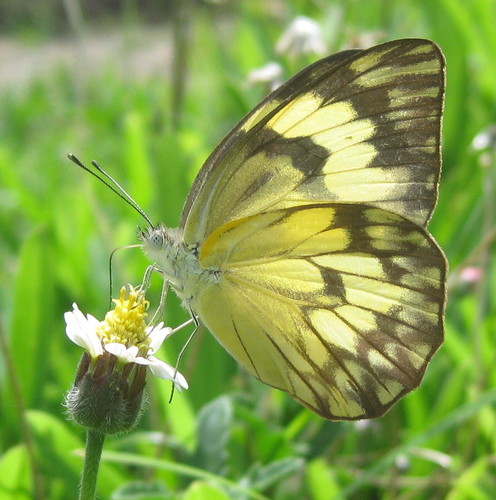
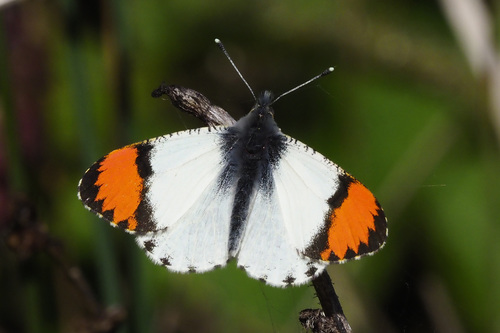
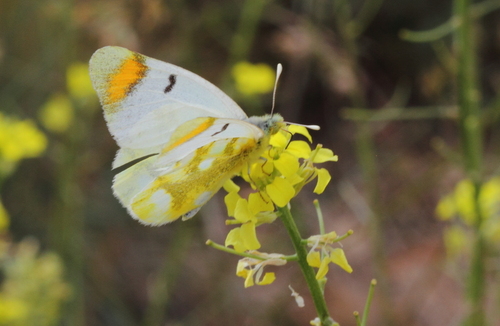
Zegris eupheme (Esper, 1804), as described in Seitz, occurs in southeastern Russia, Armenia, and the Alatau. The forewing upperside is white with a dark apex that bears an orange-red spot, and the black median spot of the forewing is half-moon shaped. The orange spot is usually smaller in females, and is sometimes absent entirely. The underside of the wings is white: the forewing has a yellow apex and a black median spot, while the hindwing is greenish yellow with white spots. Specimens with particularly prominent white spots are classified as ab. tschudica H.-Sch., a synonym of Z. e. erothoe. The subspecies menestho Mén., found in Asia Minor and Western Kurdistan, is somewhat larger than the nominate form, and has a more yellow hindwing underside. The taxon meridionalis Led., now raised to full species status as Zegris meridionalis meridionalis Lederer, 1852 from central and southern Spain, is larger still, with an almost uniformly yellow hindwing underside marked with grey-greenish markings. The larva is thick, cylindrical, and densely hairy. The pupa is stout, enclosed in a dense cocoon that still retains a remnant of the characteristic silk thread found in pierid pupae. In Armenia, Zegris eupheme inhabits dry grasslands including semi-deserts and arid steppes, as well as juniper woodlands and tragacanth steppe areas that develop as forests are replaced on eroded slopes. In this region, the species occurs at elevations ranging from 400 to 2,000 m (1,300 to 6,600 ft) above sea level.