About Zebrasoma xanthurum (Blyth, 1852)
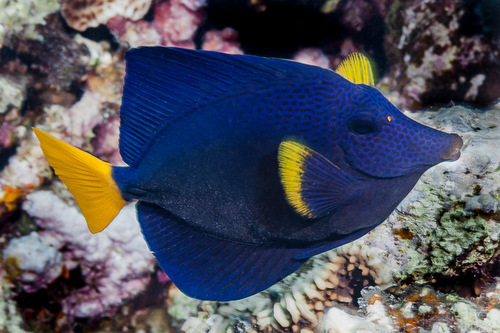
Zebrasoma xanthurum, commonly called the yellowtail tang, has a dorsal fin supported by 5 spines and 24 or 25 soft rays, while its anal fin is supported by 3 spines and 19 or 20 soft rays. This species has a deep, laterally compressed body, a protruding snout, and tall dorsal and anal fins. The body depth measures 1.7 to 1.9 times the fish’s standard length, and the longest dorsal fin ray measures 3.3 to 3.7 times the standard length. The snout has a concave profile on both its upper and lower sides. There is a velvet-like patch of bristles on the caudal peduncle, located anterior to the spine. Juveniles have a rounded caudal fin, while in adults the caudal fin may be slightly rounded or truncate. The head and body of adult Zebrasoma xanthurum are dark blue to purple, which contrasts with their bright yellow caudal fin. Black spots mark the head and anterior part of the body, and these spots extend onto the adjacent fins. Irregular black horizontal lines cover the rest of the body and fins, excluding the caudal fin, and the outer third of the pectoral fins is yellow. Juveniles and subadults have dark brown longitudinal lines on their bodies. The maximum published total length of this species is 36.7 cm (14.4 in), though a total length of 10 cm (3.9 in) is more typical. Zebrasoma xanthurum is endemic to the northwestern Indian Ocean. It occurs in the Red Sea, the Gulf of Aden, around the coasts of the Arabian Peninsula extending into the Persian Gulf, and around Socotra. A 2015 record of the species from Sardinia is thought to come from an aquarium release. A record from the Maldives is considered a misidentification, and the recorded type locality of Sri Lanka is thought to be an error. These fish form groups and inhabit coral-rich or rocky areas at depths down to 20 m (66 ft).