About Zebrasoma veliferum (Bloch, 1795)
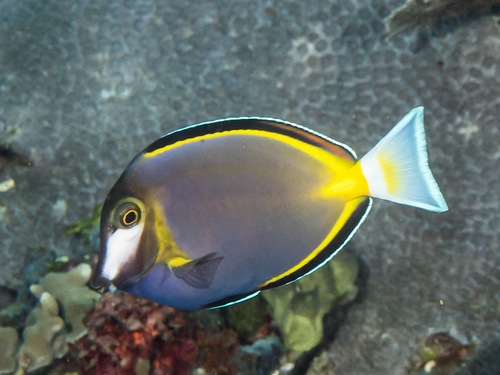
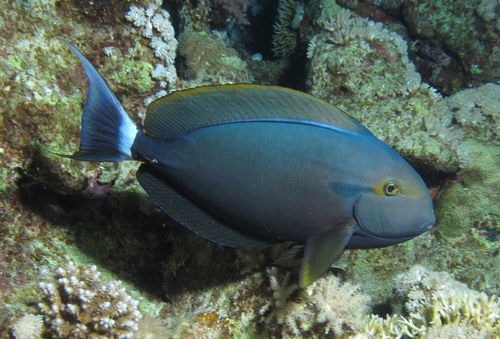
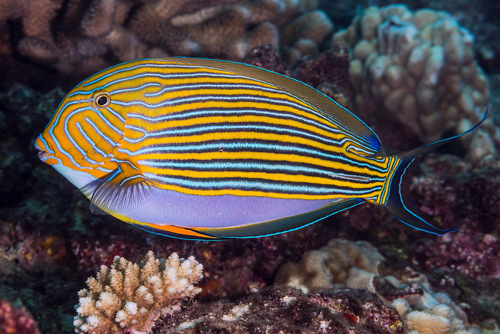
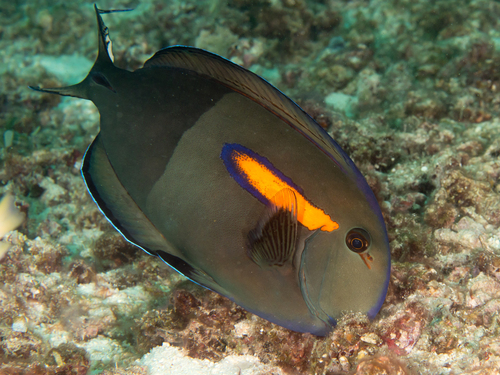
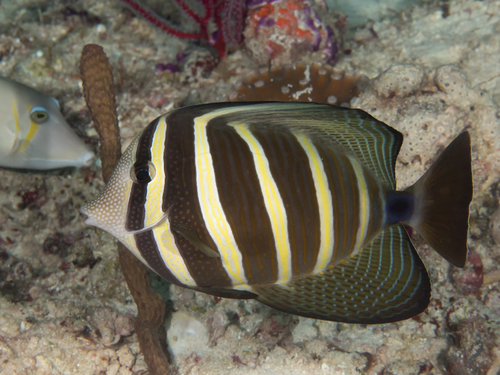
Zebrasoma veliferum, commonly known as the sailfin tang, has a dorsal fin supported by 4 or 5 spines and between 29 and 33 soft rays, while its anal fin is supported by 3 spines and 23 to 26 soft rays. It has a disc-shaped body with very tall dorsal and anal fins; when its fins are fully extended, the fish's total height is almost equal to its length. It also has the elongated snout that is typical of the Zebrasoma genus. This is a brownish fish marked with wide greyish brown bars separated by narrower yellow bars. Its dorsal and anal fins are dark greyish to brown, marked with paler bands. The caudal fin ranges in colour from greyish brown to yellow. Its white head is covered with yellow spots, with a dark band running through the eye and a second, slightly paler band located immediately behind the eye. The bands on the head are also marked with yellow dots and lines. Juvenile specimens look similar to adult fish, but have more intense yellow colouring. This species has a maximum published standard length of 40 cm (16 in). The sailfin tang is primarily found in the Pacific Ocean. Its westernmost distribution reaches Christmas Island in the eastern Indian Ocean and the eastern coast of Indo-China, and it extends east through the Pacific as far as the Pitcairn Islands and Hawaii, including the Northwestern Hawaiian Islands. It ranges north to Japan and south to Australia and Rapa Iti, and is absent from the Marquesas Islands. In Australia, this species occurs from Rottnest Island to the Montebello Islands and around offshore reefs in Western Australia; it is also found at Ashmore Reef in the Timor Sea, on the northern Great Barrier Reef extending south to Moreton Bay in Queensland, with juveniles reaching as far south as Sydney. Additional populations are found off Middleton Reef, Elizabeth Reef, and Lord Howe Island. The sailfin tang is benthopelagic and inhabits lagoon and seaward reefs at depths down to 45 m (148 ft). Juveniles are solitary and live on sheltered coral and rocky reefs, though they may occasionally be found in turbid areas.