About Zebrasoma scopas (Cuvier, 1829)
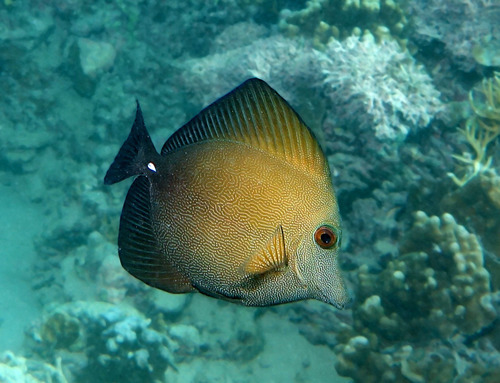
Zebrasoma scopas (Cuvier, 1829) is a laterally compressed, deep-bodied fish with a protruding snout, that reaches a maximum published standard length of 40 centimetres (16 in). Its head is whitish, and its body is pale brown that darkens to brownish-black close to its black tail. Faint pale green longitudinal lines run across its body, starting as dots at the head end, becoming continuous mid-body, and turning dotted again towards the posterior. Juveniles are paler overall than adults, have yellowish bars near their anterior end, and relatively larger dorsal fins. Adults have a white spine on the caudal peduncle. Its large, sail-like dorsal fin holds 4 or 5 spines and 23 to 25 soft rays, while its anal fin holds 3 spines and 19 to 21 soft rays. This species is native to the Indo-Pacific region, where it lives at depths up to 60 metres (200 ft). Its native range extends from the coasts of East Africa to Japan, the Pitcairn Islands, Malaysia, Indonesia, Australia, Lord Howe Island and Rapa Iti. In 2008, a brown tang (the common name for this species) was observed near Fort Lauderdale, Florida, far outside its native range. Zebrasoma scopas is readily available in the aquarium trade, and is one of the easier tang species for novice aquarists to keep. It does not bother coral, so it is safe to keep in a reef aquarium. It is smaller and less aggressive than other members of the surgeonfish family Acanthuridae, and is one of the more peaceful species in its genus, so it can be kept with other tang species. Brown tangs require an aquarium of at least 75 gallons, and are more tolerant of a wide range of living conditions than other tangs. They will accept a variety of foods including meaty items, but vegetable matter should make up the main part of their diet. They also eat algae that grows inadvertently in home aquariums.