About Zebrasoma flavescens (Bennett, 1828)
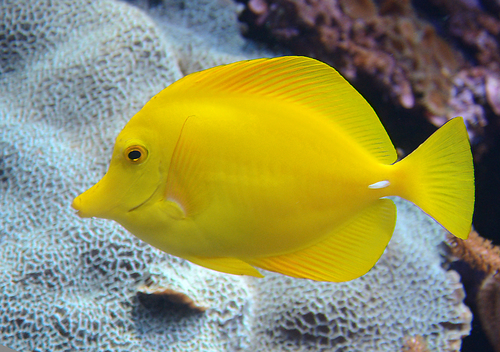
Zebrasoma flavescens (Bennett, 1828), commonly called the yellow tang, is a marine reef fish. Adults reach a maximum length of 20 centimetres (7.9 in), with a body thickness of 1–2 centimetres (0.39–0.79 in), and adult males are typically larger than females. Male and female yellow tang have very similar external appearances. Their body is a consistent bright yellow color. At night, their yellow color fades slightly, and a distinct brownish patch forms on the middle of the body, paired with a horizontal white band; they rapidly return to their bright yellow daytime coloring once daylight returns. During mating, males change color and display a "shimmering" behavior that allows them to be distinguished from females. This species has 5 dorsal spines and 23–26 soft dorsal rays, along with 3 anal spines and 19–22 soft anal rays. A sharp white defensive spine sits on its caudal peduncle. Its snout is moderately protruding, and it has a small mouth holding closely spaced, spatulate teeth. Juveniles have 12 upper teeth and 14 lower teeth, while adults have 18 upper teeth and 22 lower teeth. Yellow tang are naturally found alone or in small groups on reefs. They are primarily herbivorous. In the wild, they feed on benthic turf algae and other marine plant material, and they also provide cleaner services to marine turtles by removing algal growth from turtle shells. Yellow tang can be aggressive, are prone to developing marine ich, and may damage coral when kept in reef aquariums. This species is native to the Pacific Ocean, where it inhabits shallow tropical reefs at depths between 2 metres (6.6 ft) and 46 metres (150.9 ft). It occurs around the Ryukyu, Mariana, Marshall, Marcus, Wake, and Hawaiian islands, in the range west of Hawaii and east of Japan. There are reported sightings of the species off the coast of Florida in the Western Central Atlantic. A single individual was filmed in Spanish Mediterranean waters in 2008, and this individual is believed to be an aquarium release. As of July 2024, yellow tang have been spotted multiple times on shallow reefs in Mexico's Riviera Maya. The species prefers tropical water temperatures between 24–28 °C (75–82 °F). Before Hawaii implemented an export ban, it was the most common source of yellow tang for the aquarium trade, with up to 70% of aquarium-sourced yellow tangs coming from Hawaiian waters. More than 70% of the species' natural range is protected from collection and fishing. The International Union for Conservation of Nature (IUCN) lists the yellow tang as Least Concern. Spawning occurs year-round, with a single annual peak that usually coincides with the full moon, indicating that the species' spawning behavior follows lunar periodicity. Spawning can take place in pairs or groups, with external fertilization. Yellow tang are open-water substratum egg scatterers, and they do not guard their eggs. After eggs hatch, juveniles receive no parental care. Yellow tang larvae can drift more than 100 miles to reseed distant locations. In captivity, yellow tang are often fed meat- or fish-based aquarium food. The long-term health effects of this diet alone are questionable, but most marine aquarium experts do not believe a balanced diet that includes both plant and animal material is harmful to this mostly herbivorous species, as yellow tang occasionally require complex amino acids and nutrients only found in animal material.