About Zebrasoma desjardinii (Bennett, 1836)
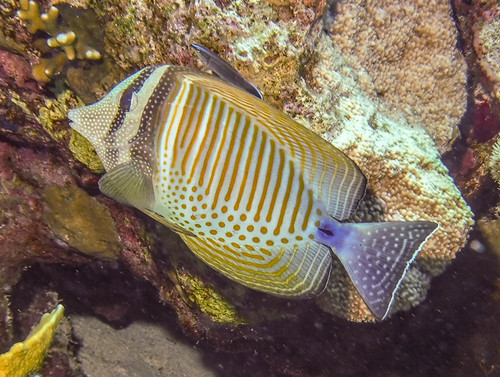
Zebrasoma desjardinii has a tall dorsal fin with 4 spines and 27 to 31 soft rays; the longest soft ray measures approximately half the species' standard length. Its anal fin has 2 spines and 22 to 24 soft rays. This fish has a deep body, where the standard length is 1.8 to 2 times the body depth. The maximum published total length for this species is 40 cm, or 16 inches. Its mouth protrudes, and the snout has a concave profile. The spine on the caudal peduncle connects to the body via a narrow posterior attachment, and the caudal fin is truncate. The body is grey, marked with around 8 dark grey vertical bars. Each bar holds 2 to 3 vertical orange or yellow lines, which break up into spots toward the lower body and on the anal fin. There are 2 dark brown bars on the head, with the first bar passing through the eye. A dense pattern of small, light yellow spots covers the head and body, and a similar spotted pattern arranged in bands may appear on the dorsal fin. The caudal fin is marked with pale blue spots. Juveniles have slender grey and yellow bars on the body, and 2 black bars on the head. Zebrasoma desjardinii is native to the Indian Ocean. Its distribution includes the eastern coast of Africa, ranging as far south as Sodwana Bay, South Africa, and coastal areas of the Middle East including Israel, Saudi Arabia, and Yemen. It is also found across Indian Ocean islands and landmasses, including Sri Lanka, Andaman Sea islands, Sumatra, Java, the Cocos (Keeling) Islands, and Christmas Island. In 1999, a pair of this species was recorded in the Atlantic Ocean off Florida; this occurrence is most likely the result of an aquarium release. This species inhabits lagoon and seaward reefs at depths between 1 m (3 ft 3 in) and 30 m (98 ft 5 in). Juveniles are most often found in sheltered areas within reefs.