About Zeatrophon ambiguus (R.A.Philippi, 1844)
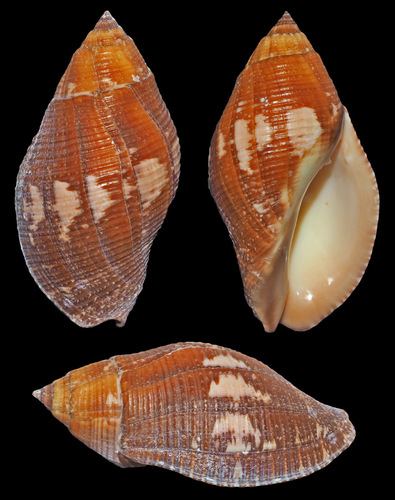
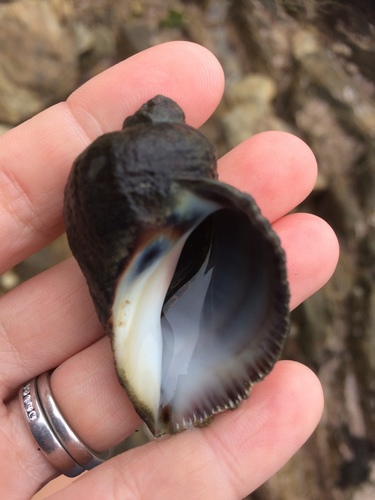
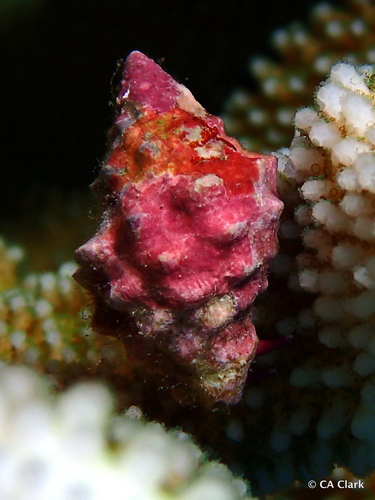
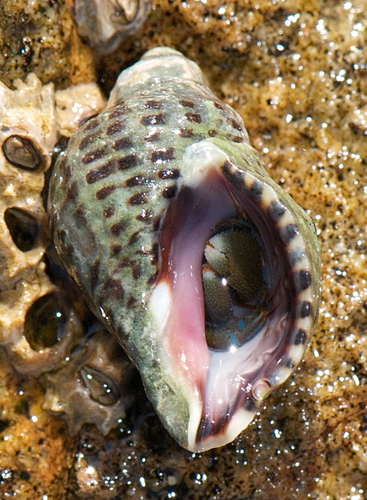
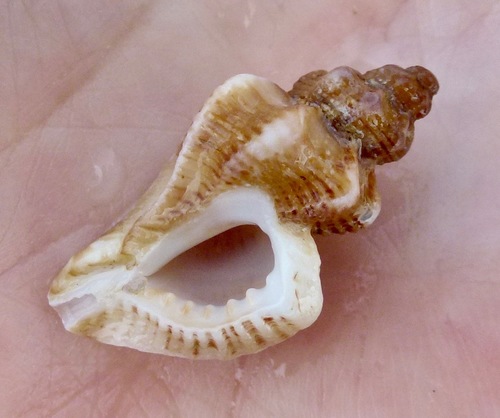
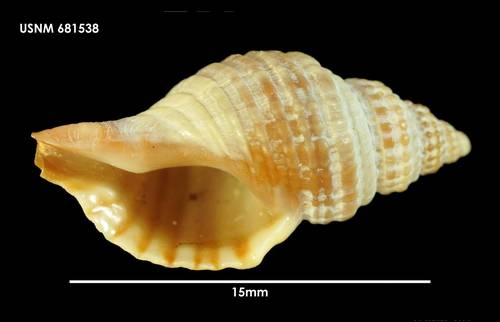
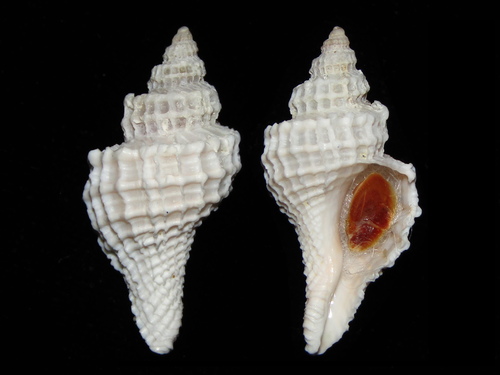
This species has the accepted scientific name Zeatrophon ambiguus (R.A.Philippi, 1844), originally described under the name Trophon ambiguus. Adult shells of this species reach up to 56 mm in length and 31 mm in diameter. The shell is fusiform, turriculate, not very thick, and usually has an umbilical chink. Its surface is reticulated by intersecting spiral and axial ribs that form the shell’s sculpture. Each spire whorl has two spiral ridges, with the upper ridge sitting on the whorl’s carina; occasional finer spiral ridges can be found in the spaces between the main ridges. The body whorl has numerous spirals of uneven size, and some of these are typically more prominent than the others. A distinct fasciole runs along the siphonal canal. Axial sculpture on the spire whorls is made of subequal sharp varices, which are very unevenly spaced and often almost completely absent on the body whorl. The points where the spiral and axial sculpture intersect are nodulous, especially on the whorl carina, and may be extended into short hollow spines. The exterior of the shell is white or yellowish, while the interior of the shell is white, greenish, or light brown. The spire is conical, and is shorter than the aperture combined with the siphonal canal. The protoconch is made of 2.5 convex, smooth whorls, with a minute rounded nucleus. There are between 1 and 8 teleoconch whorls, each with a broad, flat, only slightly sloping shoulder that becomes lightly convex below the shoulder. The base of the shell contracts toward the siphonal canal, and the suture is not deeply impressed. The aperture is ovate, broadly angled at the upper end, and extended below into a moderately long, open siphonal canal that is recurved and bent to the left. The outer lip is usually thin and sharp, but is often much thickened on the interior in older specimens. It is generally finely crenulated, though it may sometimes be almost smooth. It is distinctly angled above, and contracts as it approaches the siphonal canal. The columella is vertical and somewhat excavated. The inner lip is thin, extends a short distance beyond the columella, and has a well-defined margin. It forms a more or less thick callous layer on the concave parietal wall, and narrows toward the bottom into a fine sharp ridge. The fasciole is well-defined and lamellar, the umbilical chink is mostly distinct, and the operculum has a subapical nucleus. For the species’ dentition: the central tooth is transverse, and has 5 cusps. The median and external cusps are much larger than the other cusps, and all 5 cusps are joined at the base. The lateral teeth are angled and unicuspid. This marine species is endemic to New Zealand.