About Zea mays L.
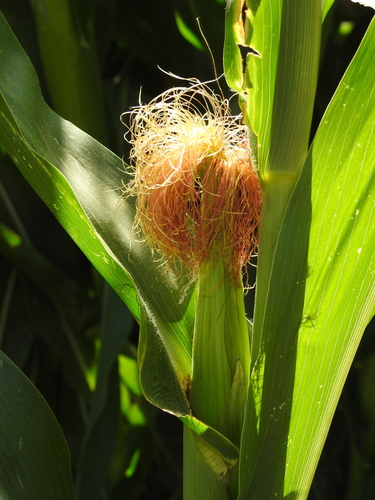
Maize (Zea mays L.) is a tall annual grass that typically grows a single stem between 1.2 and 4 meters (4 to 13 feet) in height. Its long, narrow leaves grow from the stem’s nodes (joints), arranged alternately on opposite sides of the stalk. This species is monoecious, meaning it produces separate male and female flowers on the same individual plant. A cluster of male flowers called a tassel forms at the top of the stem; its anthers release wind-dispersed pollen. The female inflorescence develops partway down the stem, below the tassel. It first appears as a silk: a bundle of soft tubular hairs, with one hair for the carpel of each female flower. Once pollinated, each female flower develops into a kernel, commonly called a seed. Botanically, like all grass grains, this structure is a fruit called a caryopsis, with its fruit wall fused to the seed coat. The entire female inflorescence matures into an ear, or corncob, wrapped in multiple leafy protective layers called husks. The ear leaf is the leaf positioned closest to a specific developing ear. This leaf and the leaves above it produce over three-quarters of the carbohydrate (starch) that accumulates in the mature grain. Modern maize varieties usually have yellow or white grains, while older or specialty varieties can have orange, red, brown, blue, purple, or black grains. Grains are arranged in 8 to 32 rows around the central cob, and a large cob can hold up to 1200 grains. Yellow grains get their color from carotenoids, red grains get their color from anthocyanins and phlobaphenes, and orange or green varieties can contain combinations of these pigments. Maize exhibits short-day photoperiodism, which means it requires nights of a specific minimum length to initiate flowering. Flowering also requires a sufficient number of warm days with temperatures above 10 °C (50 °F). The timing of flowering is genetically controlled, and the physiological mechanism that regulates it relies on the phytochrome system. When grown at higher latitudes, tropical maize cultivars often do not perform well: longer summer days cause the plants to put energy into growing tall instead of developing seed before winter arrives. However, this rapid tall growth can be useful for producing biofuel. Immature maize shoots accumulate a potent antibiotic compound called 2,4-dihydroxy-7-methoxy-1,4-benzoxazin-3-one (DIMBOA), which helps protect the plants against a wide range of pests. Because maize has shallow roots, it is vulnerable to droughts, cannot tolerate nutrient-poor soils, and is easily uprooted by severe wind. Maize pollen is an allergen, but most pollen falls within a few meters of the tassel, so allergy risk is largely limited to farm workers.