About Zapyrastra calliphana Meyrick, 1889
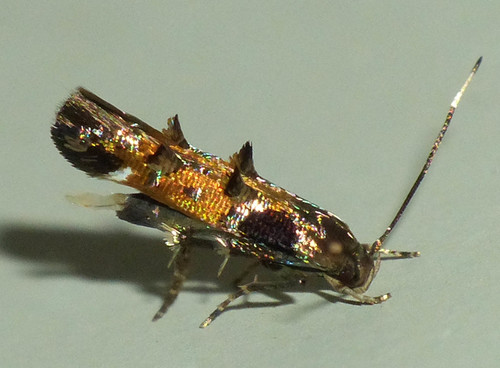
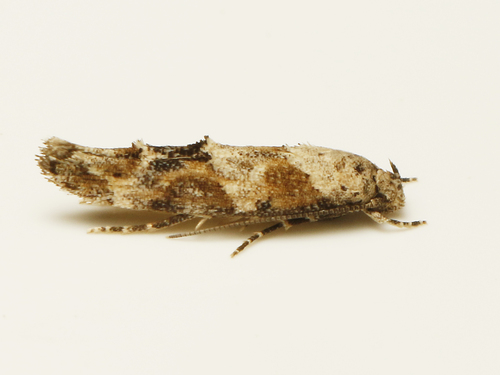
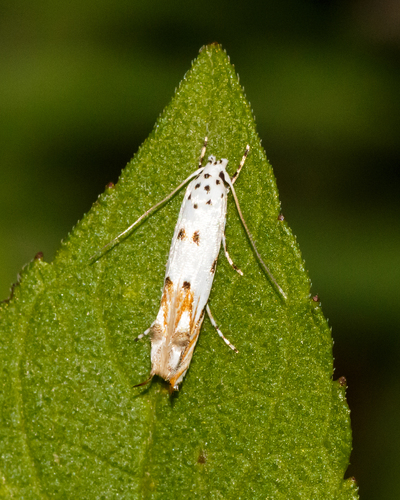
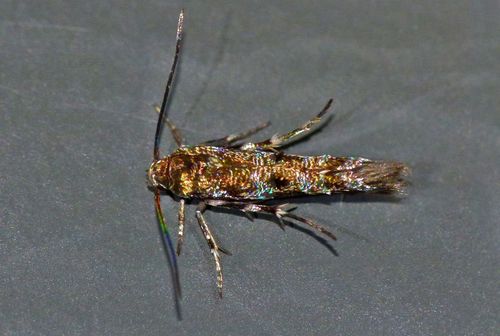
When Edward Meyrick first described Zapyrastra calliphana, he gave the following details. Both male and female individuals have a wingspan of 5 to 8 mm. The head, palpi, antennae, thorax, abdomen, and legs are dark shiny bronze, while the face is whitish-bronze, and legs have white spots. The forewings are lanceolate-shaped and bright dark golden-bronze, with markings that are pale violet-golden-metallic. Markings include a frequently ill-defined fascia close to the base, a nearly straight perpendicular fascia before the middle of the wing, a discal dot beyond the middle with a black dot or small spot on the fold beneath it, an inwardly-oblique fascia at the 3/4 position, a small spot on the anal angle, a streak along the hindmargin extending from the apex, and a small triangular snow-white spot on the costa near the apex. Cilia are fuscous-grey, with two blackish lines around the apex and a tiny white dot above the apex. Hindwings are dark fuscous, with fuscous-grey cilia.
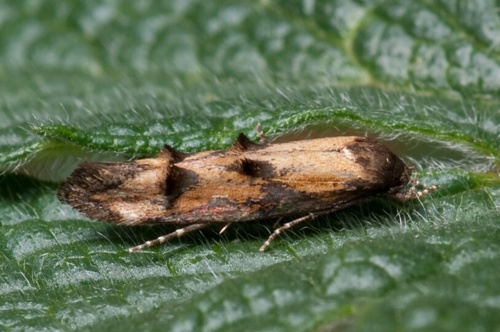
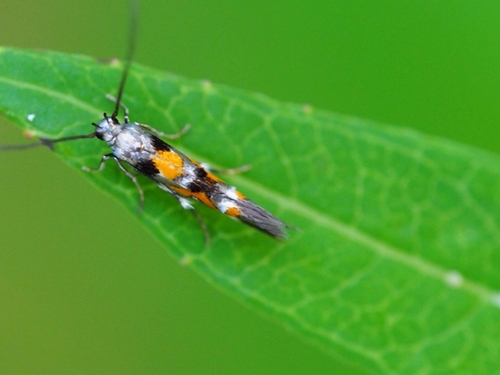
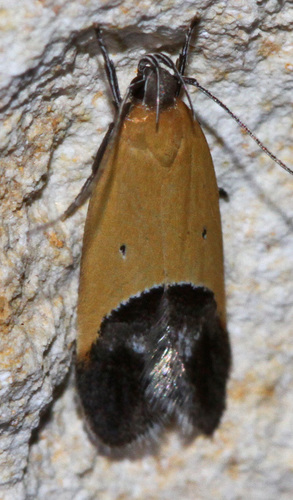
Two species are very similar in appearance to Z. calliphana. The first is Z. stellata, which is only found in the eastern parts of New Zealand's South Island. The second is currently an undescribed species that occurs in the North Island; the larvae of this undescribed species mine leaves of plants in the genus Haloragis.
Z. calliphana is distributed throughout New Zealand, including Manawatāwhi / Three Kings Islands, and can also be found on the Norfolk Islands. This species lives in a variety of habitats, including native forest clearings, coastal dunes, and shrubland. The larvae of Z. calliphana feed on plants in the genus Muehlenbeckia, specifically Muehlenbeckia australis and Muehlenbeckia complexa.
Larvae of this species create leaf mines within Muehlenbeckia leaves, and pupate inside the mine inside a self-made cocoon. It is likely that this species has several generations over the summer months, with one generation overwintering in the pupal stage. Adults are most commonly active on the wing during spring and summer, from October to January, though adults have been recorded as late as March, and have been observed emerging from pupae in July in captive settings. This is a day-flying moth species that can be seen flying around its larval host plants in sunshine, though it is hard to spot due to its very small size. Z. calliphana has been collected using malaise traps.