About Zapteryx exasperata (Jordan & Gilbert, 1880)
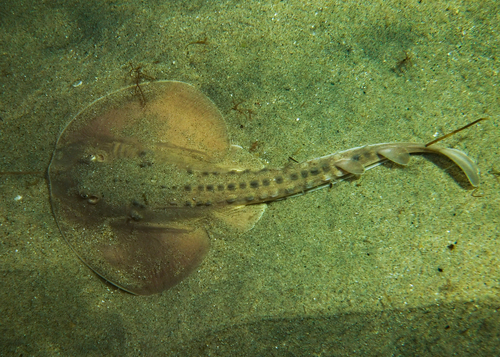
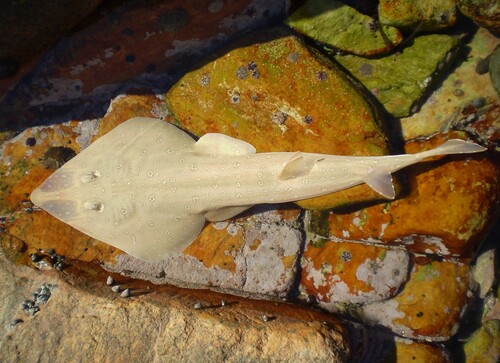
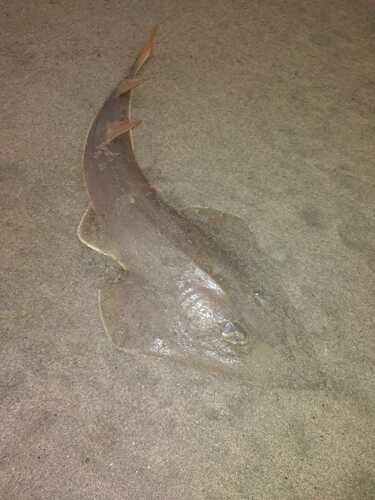
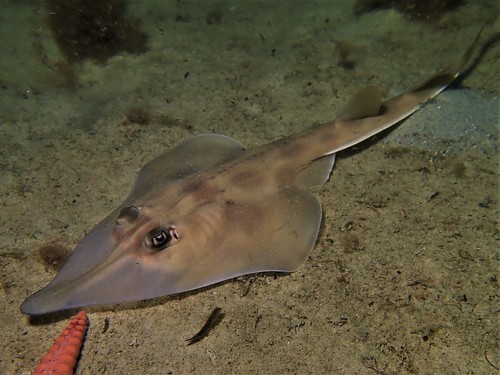
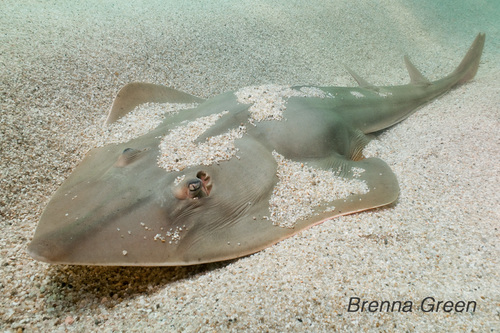
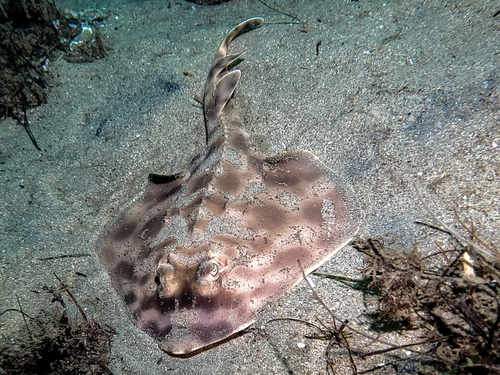
Banded guitarfish (Zapteryx exasperata) have diamond-shaped bodies that resemble guitars, as their common name suggests. Their coloration ranges from dark gray to sandy brown, with distinct black or dark brown banding along their back. They typically have large eyes and a short, rounded snout. Their tail is thick from the base of the body disc to its rounded caudal fin, and is equal in length or shorter than the disc. Their skin has a rough texture, caused by prickles and tiny spikes covering the entire dorsal surface, with a line of larger spikes running down the center to the first dorsal fin.
Zapteryx exasperata is very closely related to Zapteryx xyster, making the two species relatively hard to tell apart. Key distinguishing features of Z. exasperata are that its body disc is equal in length and width, and it lacks the yellow eyespots that are present on Z. xyster. The oldest studied banded guitarfish was estimated to be 22 years old. On average, females live to 18 years old, while males have an average age of 14 years. The maximum recorded total length of this species is 124 cm. Banded guitarfish show allometric growth and sexual dimorphism, with females growing much larger than males.
The reproductive cycle of banded guitarfish lasts one full year. Gestation is thought to last 3 to 4 months, after which birth takes place in shallow, sandy bays in late July or early August, when water temperatures are warmest. As ectothermic poikilotherms, banded guitarfish depend on environmental heat to regulate their metabolism and growth, so warm temperatures improve neonatal growth outcomes and survival. Litter size depends on the size of the mother, ranging from 4 to 11 offspring with an average of 7. Newborn neonates have an average total length of 18 cm.
Males reach sexual maturity at a total length of 68 cm, around 7 years of age, while females reach maturity at around 77 cm total length, or about 9 years old. Banded guitarfish have low population growth, because they produce small numbers of offspring per reproductive cycle, and those offspring mature slowly. Their embryo development is classified as lecithotrophic yolk sac viviparity: eggs hatch inside the mother, and the embryo uses a yolk sac as its main source of nutrition. In adult populations, more females than males are typically observed, but male and female embryos are found in equal numbers.
Banded guitarfish have different reproductive cycles and socialization patterns depending on their environment. In Baja California Sur, Mexico, sexual segregation is well-documented: females occupy shallow areas to give birth, and males do not enter these areas. The two sexes only meet again in spring to mate, then separate shortly after. In this population, the ovarian cycle occurs long before the rest of the reproductive cycle. This differs from banded guitarfish in the Gulf of California, where gestation begins immediately after the ovarian cycle. Gulf of California banded guitarfish also experience embryonic diapause, which still results in births occurring in July or early August. Sexual segregation is not observed in this Gulf of California population. It is hypothesized that environmental pressures drive these differences between populations, but little research has been done to confirm the exact cause.