About Zantedeschia aethiopica (L.) Spreng.
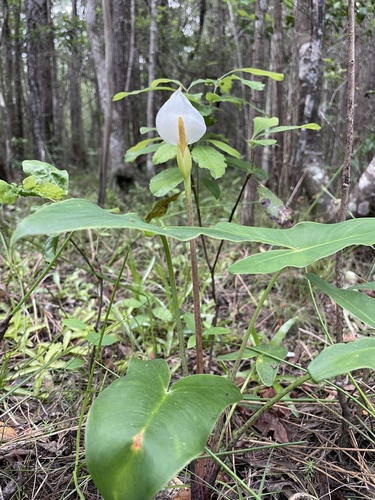
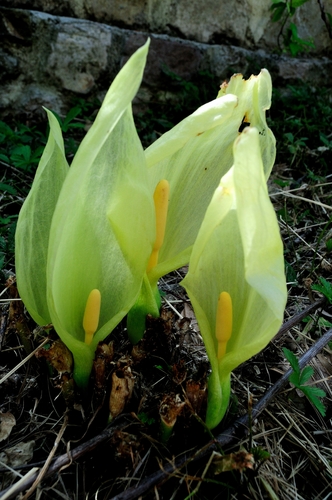
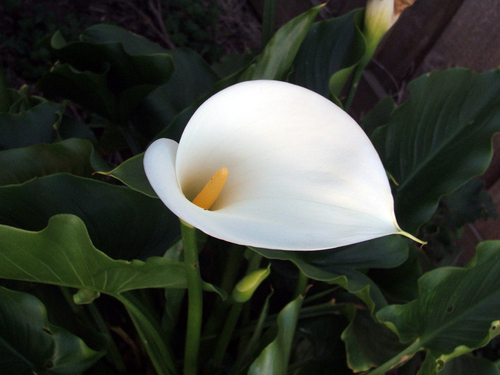
Zantedeschia aethiopica (L.) Spreng. is a rhizomatous herbaceous perennial plant. It stays evergreen in regions with adequate rainfall and temperatures, and becomes deciduous in areas that have a dry season. Its preferred habitat is within streams and ponds or on their banks. It grows to 0.6–1 m (2.0–3.3 ft) tall, and forms large clumps of broad, arrow-shaped dark green leaves that can reach up to 45 cm (18 in) long. It produces large inflorescences from spring through autumn, with a pure white spathe up to 25 cm (9.8 in) long and a yellow spadix up to 9 cm (3+1⁄2 in) long. The spadix gives off a faint, sweet fragrance. This plant contains calcium oxalate. If raw plant material is ingested, it may cause a severe burning sensation and swelling of the lips, tongue, and throat; stomach pain and diarrhea may also occur. Z. aethiopica is native to southern Africa, specifically Lesotho, Mozambique, South Africa, and Eswatini. It has become naturalized in Kenya, Madeira, the Azores, Malawi, New Zealand, Tanzania, Zambia, coastal California, western Europe from the Iberian Peninsula to Ireland, high altitude mountainous areas of Luzon in the Philippines, and Australia, particularly in Western Australia, where it has been classified as a toxic weed and pest. Most invasive populations of this species grow in coastal prairies and wetlands near human settlements. It is also a highly invasive species in riparian zones and pastureland of Western Australia and New Zealand. The cultivar 'Green Goddess' is listed in the New Zealand National Pest Plant Accord, which bans its cultivation, sale, and distribution. Z. aethiopica reproduces via seeds dispersed by birds, and via vegetative propagation through rhizomes, which can spread when soil or garden cuttings are moved. A number of cultivars have been selected for use as ornamental plants. 'Crowborough' is a more cold tolerant cultivar that grows to 90 cm (35 in) tall, and is suited to cool climates such as those in Ireland, Britain, and the north-western United States. 'Green Goddess' has green stripes on its spathes that make its flowers last much longer than the original white form. It also has a more opened, wider spathe, and tends to develop curvy fringes along the edge of the spathe compared to the original white form. First-generation hybrids between 'Green Goddess' and the original white form have a light green underside on their spathes that lets the flowers last longer than the original white form, but do not have green stripes on the top side of the spathe. 'Pink Mist' has a pinkish base to the spathe and a pink spadix. It is not a hybrid, but a color sport. Its pink color develops best in partial shade after rain. 'Pink Mist' is quite delicate and weaker than the original white form and 'Green Goddess'. Unlike those two cultivars, 'Pink Mist' has a dormant period during winter where its leaves die down almost completely, even though it is a pure Z. aethiopica. The seedlings of 'Pink Mist' are also weaker than those of the original white form or 'Green Goddess'. 'Red Desire' has a red spadix instead of a yellow one, and is considered very rare. 'White Sail' grows to 90 cm tall, and has a very broad spathe. The cultivars 'Crowborough' and 'Green Goddess' have earned the Royal Horticultural Society's Award of Garden Merit. To introduce new colors to large white calla lilies, matching the variety of colors available in dwarf summer calla lilies, people have attempted to hybridize Z. aethiopica with Z. elliotiana. These attempts have only produced non-viable albino progeny. Zantedeschia aethiopica can be used to treat wastewater, because it tolerates iron and can grow in wet areas.