About Zanclus cornutus (Linnaeus, 1758)
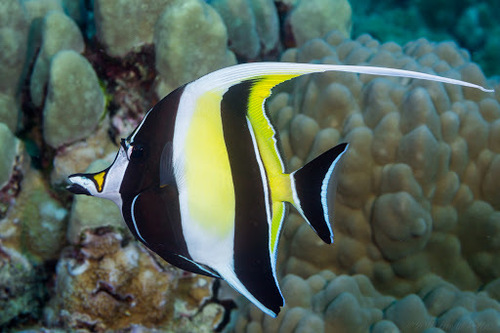
The Moorish idol possesses a body that is highly compressed laterally and shaped like a disc, featuring a tube-like snout and small bony protrusions above the eyes in adults. Its mouth is small with numerous long, bristle-like teeth, and there are no spines or serrations on the preoperculum or caudal peduncle. The dorsal fin consists of 6 or 7 elongated spines that extend into a filament resembling a whip, along with 39 to 45 soft rays. The anal fin has 3 spines and between 31 and 37 soft rays. The maximum recorded total length is 23 cm (9.1 in), though 21 cm (8.3 in) is more common. The coloration features a white background with two broad black vertical bands, a yellow patch on the rear portion of the body, and a yellow saddle on the snout, while the caudal fin is black with a white edge. The Moorish idol is widely distributed across the Indian and Pacific Oceans, found from the eastern coast of Africa (between Somalia and South Africa) to Hawaii and Easter Island, and in the eastern Pacific from the southern Gulf of California to Peru, including the Galapagos and Cocos Islands. They inhabit depths between 1 and 180 metres (3 ft 3 in – 590 ft 7 in) in turbid lagoons, reef flats, and clear rocky or coral reefs, with habitat significantly influencing their abundance. In terms of reproduction, these fish are pelagic spawners, where males and females release sperm and eggs into the water, allowing them to drift away post-fertilization. Similar to their related family, Acanthuridae, the Moorish idol produces larvae that are adapted for an extended pelagic life stage. The pre-juvenile larvae can grow up to 60 mm before settling into their habitats. Various larval stages have been documented, including the preflexion stage, where hatchlings lack fin spines, soft rays, or internal support for the fins but start developing dorsal and anal fins by 3.2 mm. The larger preflexion larvae exhibit cartilaginous supraoccipital crests with 23 to 26 curved dorsal spines, with pigmentation increasing as size grows. The postflexion larval stage, which precedes juvenile settlement, features fully developed fins, a compressed and deep-bodied form, a small terminal mouth, and a kite-shaped body. They possess seven dorsal spines covered in small spines, with the third dorsal spine being particularly elongated (approximately 1.2 times their standard length), alongside one pelvic fin spine and three anal fin spines also adorned with small spines.

